3/21/12

Naturalism on Speed: Challenge 2

Welcome back to the silliest feature of my blog, the Naturalism on Speed Challenge. Last year I challenged myself to identify 50 species before the CASA River Century and another fifty by the end of the year. This time I'm going for fifty more, for a grand total of 153. I expect this one to be much harder because so many of the most familiar species are eliminated. Further, since there are only so many terrestrial animals likely to show themselves I will be primarily identifying plants (outside my wheelhouse) and squinting at birds (which move as quickly as I do). I suppose insects might be a promising well to draw from, but those are, well, very small.

As with last time, I'm sure I won't have pictures of everything. After all, I have specifically stated that stopping to get a better look is off-limits, and I haven't mastered the art of photography from the back of a moving bicycle (and will never attempt to do so). Fortunately, the first few species this year are a product of some new wildflower knowledge I picked up within the last week or so, and so I happen to have a few pictures to show off. The top photo is bloodroot, which is sort of sneaky-beautiful Easy to overlook but worth the time to stop for. Photo two is a blanket of lesser celandine, while the third is the familiar mountain laurel.

Some of these may just get their own species features (I'm looking at you, bloodroot). Bloodroot and lesser celandine were the inspiration for returning to this project. They are beautiful wildflowers which bloom in early spring - a refreshing burst of color after months of grays and browns. Violets show equally early and are equally refreshing, but there are quite a few similar species and I have little hope of nailing them down as I rider by. I'm pleased to add mountain laurel this time,  because this was on the "how do I not have this yet" list along with sassafras and chickadees.

The List

I thought about reproducing the original list in this space, but it is something of a wall of text. I'll see if I can figure out a non-obnoxious way to present it later.
  1. Ranunculus ficaria (lesser celandine)
  2. Sanguinaria canadensis (bloodroot)
  3. Kalmia latifolia (mountain laurel)
  4. Hieracium pratense (yellow hawkweed)
  5. Claytonia virginica (Virginia spring beauty)
  6. Lamium amplexicaule (greater henbit)
  7. Dryocopus pileatus (pileated woodpecker) added 3/22/12
  8. Mertensia virginica (Virginia bluebells) added 4/6/12
  9. Dicentra canadensis (squirrel corn) added 4/6/12
  10. Haliaeetus leucocephalus (bald eagle) added 4/6/12
  11. Phlox divaricata (wild blue phlox) added 4/6/12
  12. Brassica juncea (Indian mustard) added 4/15/12
  13. Geranium maculatum (wild geranium) added 4/15/12
  14. Trillium grandiflorum (large-flowered trillium) added 4/15/12
  15. Meleagris gallopavo (wild turkey) added 4/15/12
  16. Corvus corax (common raven) added 4/15/12
  17. Cardamine concatenata (cutleaf toothwort) added 4/15/12
  18. Heracleum maximum (cow parsnip) added 4/15/12
Starting with a little over ten percent accomplished feels good... but it doesn't remove the daunting nature of the task ahead.

Grainy photo of pileated woodpecker snapped in June of 2010.
That didn't take long! One day and one more species to add to the list. This was an awesome one too: the pileated woodpecker. I came across this gorgeous bird as I slipped back into the woods from a road crossing. He was sitting on a stump at about ankle height (from a cycling POV, of course) no more than a few inches from the side of the path. I guess I wasn't making a lot of noise, because he didn't take off until my front wheel was even with him. Never been even remotely that close to such a bird - and that proximity gave me a real sense of its size. It was more than a foot tall, which may not seem like much but is impressive when seen at close range.

My most recent training ride took place outside the usual habitat zone I ride in (on Shenandoah National Park's Skyline Drive, to be precise). As such, I entered with high hopes of really putting a dent in this year's challenge. I did, but not quite to the level I had hoped. Seven new species went on the books, but a few were plants I could have easily picked up in the 'burbs. Unfortunately the black bear I saw was from the car, I only heard the coyotes (at night anyway),  and I couldn't pin down the exact identity of the owl or some of the hawks I rode past. Good get on the wild turkey, though.

New species from most recent edit: 7
Running Total: 121
Animals: 44 (11 mammals, 27 birds, 4 insects, 2 reptiles)
Plants: 72
Fungi: 5

3/20/12

Back in the Saddle

I don't think fierce pedaling would be enough to escape that fellow... 

With the return of Spring (which is now official, if specious) comes the return of cycling. While I have been riding to work intermittently since the end of January, this weekend marked my first ride longer than that. That ride served as a reminder of just how awesome it is to live in the DC suburbs and own a bike capable of handling varied terrain. My route took me through urban streets in Silver Spring, down Beach Drive (closed to motorists on weekends), past (and into) the National Zoo, onto the National Mall, along the C&O Canal Towpath, and back to Silver Spring on a paved bike trail. All of this was less than a 30-mile ride.

Boulder Bridge in Rock Creek Park is one of my favorite cycling landmarks.
 
So what does a new season of cycling mean? Well, I'm doing another century ride, or the same one over again if you prefer something that sounds more zen. The CASA River Century was a lot of fun and training for it was good for me, good for the environment, and good for traffic between Silver Spring and Rockville. Dustin and I will be joined by a third rider this year, and hopefully this time it serves as a prelude to the Sea Gull Century. Other life events might make this difficult, but I think I'll be able to make it happen.

The new season also means a new Naturalism on Speed challenge for me, which may bore the bajeezus out of my readers. Even if it does, it will at the very least hone my knowledge and skills, which in turn will make me better at this*. I'm aiming for fifty new species to add to last year's final total (which will make 153 the magic number). Sunday's ride netted me five or six to get started with. A quick recap of the rules:
  1. I have to ID each species positively.
  2. I can't stop for a better look, but I can count what I see when I'm already stopped.
  3. I must know what I'm seeing when I see it - research can only help for next time.
  4. Domesticated animals and people don't count, nor do plants in planters/gardens.
  5. I can't count specimens I see all the time and thus have the chance to study thoroughly.

The sights in DC are iconic and worthwhile - and with a bike you can take in a huge number of them in just a few hours.


I'll close by reminding everyone how bike-friendly the Washington, DC area is. The Capital Bikeshare program is awesome, and there is an extensive network of trail systems. I could conceivably ride (about 90 miles) from my apartment to my parents' house just outside of Martinsbug, WV. The Metro makes it easy to close little gaps in your ride by hopping a train for a stop or two (except during weekday rush hour). The buses are theoretically all equipped to handle your bicycle.


*That's my polite way of saying "deal with it."

3/3/12

Species Feature #11, Mountain Laurel

I thought now would be a fitting time to feature this species, given my recent engagement to Laurel. While I believe she was technically named for the bay laurel (which isn't even closely related, taxonomically speaking), the mountain laurel is about as close as we're likely to find growing wild in this area. In this case "close" refers non-scientifically to plants called "laurels."

Mountain laurels have stunningly beautiful white flowers with red or pink highlights. Something I didn't realize about them is that they are evergreens... and so my prior thoughts about them as a "sign of spring" were in error. Still, I don't think they're generally quite as striking in winter as they have appeared the last few weeks.


A very photogenic plant.
 
Kalmia latifolia Quick Facts

Common Name(s): Mountain Laurel, Spoonwood, Ivybush, Sheep laurel, Lambkill, Calico bush

Taxonomic Breakdown:

  • Kingdom - Plantae
  • Division (Phylum level) - Magnoliophyta (aka Angiospermae)
  • Class - Eudicots (not technically a Class, but this is an approximation)
  • Order - Asterids (another approximation. Asterids are part of the "core Eudicots.")
  • Family -Eracaceae
  • Genus - Kalmia
  • Species - latifolia

Range:  From southern Maine to northwest Florida. It can be found as far west as Mississippi with patches in Indiana and Louisiana as well.

Showing off its evergreen properties in the snow

The ovine names above were bestowed upon the plant because of its poisonous properties. It has been known to kill sheep, cattle, and horses and is also toxic to humans. I was alarmed to read that the plant is toxic, yet used in food... and that it isn't one of those situations in which the toxicity is removed with cooking. I dare not investigate this further, lest I become paralyzed with fear.

Mountain laurels are gregarious in this area, and quite hardy. I have of course found them in Shenandoah National Park, but I have also noted their presence in myriad other places. Patuxent wildlife refuge has its share, as does Seneca Creek State Park. The flowers of course are the easiest way to identify this species, but the leaves are also fairly distinctive, at least when compared to other shrubs of the Mid-Atlantic.

The family to which it belongs, commonly referred to as the "heath' or "heather" family, is also home to a variety of familiar plants. Several berries (blueberries and cranberries, notably) are members of this family. Azaleas and rhododendrons also fit here, as do the common heathers of Europe.

Showing off its hardiness by growing from a rock.
I want to conclude with a note about the "taxonomic breakdown" I have been including in these features. It is important to note that these things are fluid, and one biologist may not agree with another over a species' placement. Further muddling this is the fact that there are even competing systems of classification, and that when it comes to plants phyla, classes, and orders are really "clades" which are not quite at the same level of biological classification. I have listed them that way to avoid confusion, and hope that I haven't instead created confusion. Believe it or not, Wikipedia is a reasonably reliable source for sorting this all out. I don't trust it to have the most current information, but it does do a good job of discussing the competing systems and, for example, what an "Angiosperm" is.

2/29/12

12 Months of Nature: February

Like February (that most dismal of months) itself, the February section of  Seasonal Guide to the Natural Year was generally short and forbidding. When conceiving this project, I had expected some months to be easier than others, and even expected to fail spectacularly at achieving the aim of my journey once or twice. But after reading my options for February, I despaired of even being able to put together a trip worthy of this blog... would "12 months of nature" become "11 out of 12 months of nature" so soon?

Option 1, "Winter Hawks" sounded promising until I discovered that all of the recommended spots were prohibitively far away. Option 2, "Tracking" seemed a little too general and unexciting for my purposes. Options 3 and 4 were titled "Lake Eerie Steelhead,"  and "Exploring Winter Beaches," respectively - both of which were also out because of travel time. The final option, "Pelagic Birding Trips," sounded fascinating but requires much more organization than I had the time or inclination to put together. Frankly, I had to look up the word 'pelagic' anyway.


February Event: Tracking

My choice of a human footprint here doesn't mean
I failed entirely...
So, I chose "Tracking" from the list above. I could have instead resigned myself to traveling a greater distance than I wanted to with a good chance of not seeing the hawks or steelhead I sought. The payoff might have been far more interesting. But the conservative approach meant that it would be hard to fail. One of my favorite places, Shenandoah National Park, was a recommended destination. There was the possibility of snow, which would only make track identification easier, in theory. Besides, the point of tracking isn't necessarily to find fauna itself, but to understand and interpret signs of its presence and impact on the environment.


The Location

I have repeatedly talked about this place, and I'm sure it will come up over and over again in this blog. So I won't bore you with redundancies (except in link form). Looking back, though, it's hard to believe I only have one post solely about Shenandoah.

Why there, and Why then?

Well, the guide was right about one thing. There was definitely snow.
The answer to "why there" was sort of unclear... really, one can track anywhere outside. Animals walk, poop, eat, and so forth everywhere. I think the guide suggested Shenandoah primarily because there is a ton of open space, and because wildlife traffic is a lot higher than most places in this region of the US. I had an ulterior motive for going to the park that most of my readers are aware of. So "why then," then? Well, I think they stuck "tracking" in February primarily because it was the toughest month to fill out with reasonable activities, but also because of the likelihood of snow.


The Trip, and What I Learned

Like the previous trip, this one was wonderful. Unfortunately I didn't learn much about tracking - I relied on a few things I already know and just enjoyed getting a good hike in in February. We got to the park pretty early, and chose one of our favorite spots: Mary's Rock. (There are those ulterior motives again). The last time we had done this hike was in the hottest part of the summer, so it was a nice change of pace (and still gorgeous) to hike it with a dusting of snow. What's nice about this hike is that although steep, it's less than a two-mile trip from the parking lot to the summit. And the view is spectacular.

The trailhead - per the sign, much of this hike is on the Appalachian Trail.

We thought this was beautiful - a veritable explosion of color amid the white, gray, and brown.

I have a couple of decent photos of the view from Mary's Rock itself, but I don't feel they do it justice. If you follow the link above there are a couple that almost get the job done, but it's one of those things you just have to see to appreciate fully. Luckily for DC denizens, it's not too far away and you don't have to be a marathon runner to pull off the climb.

When we were finished with that hike, we decided to make a quick stop at one of the park's other notable spots, Big Meadows. As usual, there were quite a few deer nearby (and signs of other fauna, which I'll get to). I have to say, though, that Big Meadows is pretty drab in the dead of winter. There's still a certain beauty to the place, and I'm glad I have seen it in its more dormant state, but I wouldn't put it at the top of my list for winter outings.
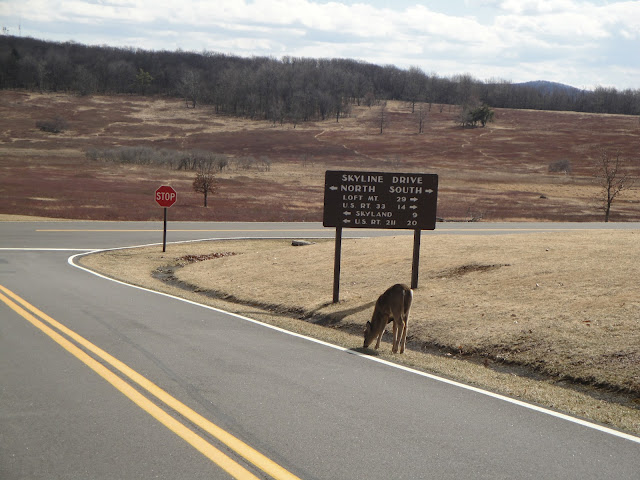
Big Meadows and one of the creatures it is famed for. As a nerd about such things, it has often bothered me that "Big Meadows" is a singular proper noun for a place composed of plural meadows. But I digress (as usual).


My guess is these were left by a squirrel. But it's hard to be
certain without a clear footprint.
 You don't even have to be an astute reader to wonder where the bit about tracking is, since that was after all the point of the exercise. Well, to be frank, we didn't find a lot of identifiable tracks, even in the snow. I think the amount of snow was such that it made it harder rather than easier - just enough to cover any visible tracks but not enough to leave good tracks. Also, the ground was still frozen. Any place where deer or some other large animal had clearly been was mostly torn up into a tangled mess. The clearest tracks were those left by fellow hikers and their canines. However, as you'll see below, footprints aren't the only signs one can use as clues to animal activity.


Deer poop
 I apologize for this next photo, but one just can't talk with any reasonable credibility about tracking without briefly discussing poop. It just can't be done. The scat at right belongs to white-tailed deer, although on this trip we also saw quite a bit of carnivores' waste as well. It could have been from foxes, coyotes, bobcats, or possibly just family pets. There was a lot of high fur content, though (you can tell just by glancing) so my guess is "coyote." In the past there was an unfortunate incident involving Franklin and some bear feces, but I don't want to talk about it. So end my scatological ramblings for the day.


A couple of other signs of note were some loose feathers, and some obvious groundhog trails. Photos of those are even more boring than photos of poop, though, so I'll let it go.

When tracking, what a good naturalist is really after is not just  an identity of what had passed this way, but a story of what it was doing and why. If the deer tracks are clustered in one muddy spot, what made them behave this way? Was it a predator? A mating display or fight for dominance? If there's loose fur, did the owner just get snagged on a twig or was there some sort of conflict? How recent are the tracks you're looking at? Was the animal moving quickly or slowly? One thing I noticed was that some of the deer scat was clustered into piles, while other spots were scattered. This led me to wonder why those particular deer were exhibiting divergent restroom behaviors. It's this type of question that can turn one from aware of nature's signs to an expert at interpreting them. Myself, I'm somewhere in between... I know how to ask the questions but not often how to answer them. Good guides on tracking do exist, though I can't offer much in the way of critique. If you're interested in learning how to track and "read sign" I suggest that you research these and select one... but it's really the experience that will teach you. I will leave you with my favorite deer picture from the day.

This young buck is showing his antler velvet... I've never managed a clear photo of this before, so I'll call it a win.

2/23/12

Further Evidence of Spring

This is more of a follow-up than its own post. I don't have a ton of new thoughts to share, but since I wrote yesterday about the signs that spring is upon us I have been hyperaware of anything that could constitute such a sign. I've been looking for them. I continue to be surprised by them. This could be thought of as a validation post (see! I'm not crazy!) There may also be an element of wishful thinking: Spring! morels! biking! BEING OUTSIDE! Laying all that aside, I'll just present some snapshots (all taken today). I'm not going to try to identify what I don't know, or go into detail about what I do know. So please, just look at the pretty things.

In this out-of-focus photo, you can see that some of the topiary at Rock Creek Springs is budding. This appears to be something related to holly, but how closely I don't know.

I don't believe these red berries usually start appearing for a few weeks.

Apparently not only are dandelions already growing, but some have even gone to seed!


Some very pretty blue flowers are also showing themselves.

Crocuses?

I saw these and thought "wow, the daffodils already have buds!" So imagine my surprise...


...when I saw these! Yes, I saved the best for last.
I know this has all been plant-based evidence of Spring. I had hoped to steal a picture or two of some of the robins and other returning birds I've been seeing, but either they weren't cooperating or I was too lazy. I was also both too early and too late to catch the bees in action today.

2/22/12

Seneca Creek State Park and the Return of Spring

I know that around here it's hard to think of this Spring as a "return" from anything. I can't recall a winter this mild. Did we crack three inches of snow? Nonetheless, the signs of mother nature waking up can already be seen, and it is a stark contrast to the grayness of early February. Why, this morning when I took the trash out I saw bees pollinating the bushes lining the front steps. Bees? Yes, bees.

The signs hardly begin and end with bees, but for me that has been the single most surprising among them. On Sunday I took a stroll to Joe's Record Paradise in Downtown Silver Spring, and along the way I noticed a number of small wildflowers already in bloom. For over a week now I have seen green shoots peeking out of the ground in various places, and I've noticed greater activity among the birds and small mammals. It seems odd to be typing this on February 22nd, but I can't argue with what I'm seeing.

Looking for a way to enjoy the warm weather and the rest of nature's early offerings, Laurel and I set out for Seneca Creek State Park on Saturday. It wasn't one of our more intense trips, but we got in a nice four-mile hike around the lake and took in some lovely sights. Unlike our previous new adventure (Monocacy), this park had a lot to offer, and I'm sure we'll be returning sometime in the future. Apart from the beauty of Clopper Lake, the Park had numerous beautiful picnic areas and pavilions. It also extended for unexplored (by us) miles along Seneca Creek. In fact, combined with other area parks, one could stroll through uninterrupted parkland from the Potomac River all the way to Damascus, Maryland. Several of the trails are also available to mountain bikers. It seems both kid-friendly and wild enough to make the most hardened naturalist happy.

Clopper Lake, the primary feature of our day's excursion.


I spoke above briefly of renewed bird activity. Well, in the park we did hear and glimpse a few songbirds, but it was still primarily waterfowl that were on display. In attendance were of course the run-of-the-mill Branta canadensis (Canada goose) and Anas platyrhynchos (mallard). However, we also sighted through binoculars a small flock of Bucephala albeola, or buffleheads. These are fairly easy to recognize by the large white patch at the back of the head (males only). The females have a smaller white stripe slightly lower on the head. I didn't get a precise count, but our flock consisted of at least a dozen birds, mostly female, although some may have been immature males and I was able to pick out for certain three adult males. Additionally, we heard the shriek of at least one bird of prey, though we never caught a glimpse of its owner and I am not nearly adept enough at discerning birdcalls to hazard a guess as to its identity.

The sign also confirmed our suspicions about the presence of beavers.
We also discovered a restoration project aimed at the American chestnut, Castanea dentata. Chestnut blight is a problem in the park, as it has apparently been everywhere the tree occurs.  I'm not sure how likely they are to preserve the trees within the park, but I salute their efforts and wish them well. We may not always know we're doing the right thing when we act on nature, but biodiversity is good and plant biodiversity is suffering greatly in this region. Here's some further reading on the tree and its plight.


I took this photo thinking these were the "shoots" mentioned in the sign above. Thanks to some vigorous Google image searching, however, I no longer think so. Whatever this plant is, I hope it doesn't out-compete the chestnuts.
In terms of other plant life, there were more green things than expected. The pines and American holly (Ilex opaca) weren't surprising, but the mountain laurel bushes already possessed a wealth of green leaves. Even the mosses and prickly vines lent a refreshing color to the landscape. Even a few grasses were peeking through the mat of dead leaves.

The blooming mountain laurels can be seen here as a faint green band.

For those interested, visiting the park is an easy trip from DC and the surrounding area. Simply take Exit 10 from I-270 and proceed East on Clopper Road. The park will be on the left. From Silver Spring this is about a thirty to forty minute drive.

1/8/12

12 Months of Nature: January

I recently discovered a book titled Seasonal Guide to the Natural Year: A Monthly Guide to Natural Events - Mid-Atlantic. Despite the unwieldy title, I was pretty excited to get into it. You see, timing can be everything for the success of a naturalist's outing, and I have never been possessed of the keenest sense for this.* I gleefully proceeded to the counter, slapped down my two bucks, and sped home. (Thank you, Friends of the Library!)

As I began paging through it that evening, I immediately started to envision a new project for From the Suburbs, Naturally. The guidebook is presented in month-by-month format, with several natural events per month. Each of the sixty entries includes recommended locations for viewing these events within the Mid-Atllantic region. I've decided to choose one entry for each month in 2012. I will explore these for myself and chronicle my attempts here. This first one was a doozy - I kind of nerded out.


January Event: Bald Eagle Viewing

This is an ambitious start. Few North American animals are as revered or as majestic as the Bald Eagle. I'm not sure I'll be able to top it in the months to come. The photos are only so good, but this trip was a resounding success. Laurel and I were able to see dozens of birds, some at surprisingly close range and all quite active. I had no idea that there was such a population of bald eagles anywhere close to us.


The Location

The suggested viewing point for wintering bald eagles was Conowingo Dam. Located near Darlington, MD on the Susquehanna River (just after it flows from Pennsylvania into Maryland), this is about a 1.5 hour trip for DC residents. I don't recommend a weekday trip, as most of your driving will be on I-95 or US 1. For a pleasant Sunday, however, this spot was well worth the drive. The dam itself is kind of nifty, and it is a paradise for birders. It is just a short drive (or medium hike) from Susquehanna State Park, which is a small but pleasant park on the river's western bank. We spent some time there after the main attraction. It wasn't particularly exciting in January, but it has potential for a spring/summer visit.


Why there, and why then?

The eagles, along with many other bird species, have identified the dam as a reliable winter food source. It blocks not only water, but fish. Further, when water is released from any of the sluices, it deposits several of these fish in the shallows - often disoriented or dead. Bald eagle numbers climb in the winter, as other food sources grow more scarce - a couple of internet sources cite as many as forty birds counted.

Dam! (Sorry, couldn't resist.) Those rocks at the far right are the tip of an island where the birds congregate, waiting for meals.


The Trip and What I Learned

Something that was entirely new to me: not all bald eagles possess the distinctive white head. In fact, it takes about five years for this to develop, and the immature bald eagles look fairly similar to the golden eagle. I'm still uncertain if any of the birds of prey we observed were golden eagles. Some of them had white markings on the wings that were remarkably similar. A related tidbit: hawks and eagles don't display the marked sex differences in plumage known to occur in smaller birds. Sexing bald eagles can be accomplished by comparing size (see the second question at the link for more).


There was only one other car in the parking lot, yet I knew we were in the right place when we got out of the car and immediately saw an eagle take flight from a nearby tree. Turns out I was wrong... the Visitor Center where we parked was about a mile from the viewing area. When we got out of the car there, though, it was hard to deny that this was the spot. People with notebooks stood behind tripods with serious cameras. I heard a shriek to my left and lo, about forty feet up and almost straight overhead sat a pair of bald eagles. Those soon took to the sky, but were replaced by a spectacle: a dining eagle.

Welcome to Dinner!
I think I may have learned a birders' lesson: if the people with the awesome technology are there, you're in the right place. I have previously learned this lesson as it relates to cycling.

None of the other eagles came remotely close enough for me to snap even a passable picture, but this was far from the end of the activity. We stayed for perhaps two hours, and never went more than a minute or two without seeing one. This is definitely a must-see spot.


 Eagles, however, weren't the sole attraction for naturalists. This site presents a list of other species seen at Conowingo, with shorebirds the main attraction for more experienced birders. Apart from the eagles, we saw black vultures, great blue herons, Canada geese, mallards, and several species of gull. I am almost certain to return at least once when my knowledge base is broader. I'm sure picking out the various species of shorebirds would be fascinating.

There was one other item of note, and it's something of an oddity to me. I noticed several dead mice scattered around the viewing area. The first seemed perfectly normal. After two more I started to wonder. Of course we were there to see birds of prey, so I wondered if they were lost meals. That's pure speculation... it could be that the dam owners use poison, or that the (mild) winter has started to hit the mouse population. I'm partial to the "dropped dinner" theory, so I'll just pretend it's that.

For anyone who is interested, the peak season for bald eagles at Conowingo Dam extends into March, and they can reportedly be seen in smaller numbers throughout the rest of the year.


*Aside: it seems I am always bringing up naturalist skills which I am deficient in. I suppose it's a combination of youth and a desire to learn more.