2/22/12

Seneca Creek State Park and the Return of Spring

I know that around here it's hard to think of this Spring as a "return" from anything. I can't recall a winter this mild. Did we crack three inches of snow? Nonetheless, the signs of mother nature waking up can already be seen, and it is a stark contrast to the grayness of early February. Why, this morning when I took the trash out I saw bees pollinating the bushes lining the front steps. Bees? Yes, bees.

The signs hardly begin and end with bees, but for me that has been the single most surprising among them. On Sunday I took a stroll to Joe's Record Paradise in Downtown Silver Spring, and along the way I noticed a number of small wildflowers already in bloom. For over a week now I have seen green shoots peeking out of the ground in various places, and I've noticed greater activity among the birds and small mammals. It seems odd to be typing this on February 22nd, but I can't argue with what I'm seeing.

Looking for a way to enjoy the warm weather and the rest of nature's early offerings, Laurel and I set out for Seneca Creek State Park on Saturday. It wasn't one of our more intense trips, but we got in a nice four-mile hike around the lake and took in some lovely sights. Unlike our previous new adventure (Monocacy), this park had a lot to offer, and I'm sure we'll be returning sometime in the future. Apart from the beauty of Clopper Lake, the Park had numerous beautiful picnic areas and pavilions. It also extended for unexplored (by us) miles along Seneca Creek. In fact, combined with other area parks, one could stroll through uninterrupted parkland from the Potomac River all the way to Damascus, Maryland. Several of the trails are also available to mountain bikers. It seems both kid-friendly and wild enough to make the most hardened naturalist happy.

Clopper Lake, the primary feature of our day's excursion.


I spoke above briefly of renewed bird activity. Well, in the park we did hear and glimpse a few songbirds, but it was still primarily waterfowl that were on display. In attendance were of course the run-of-the-mill Branta canadensis (Canada goose) and Anas platyrhynchos (mallard). However, we also sighted through binoculars a small flock of Bucephala albeola, or buffleheads. These are fairly easy to recognize by the large white patch at the back of the head (males only). The females have a smaller white stripe slightly lower on the head. I didn't get a precise count, but our flock consisted of at least a dozen birds, mostly female, although some may have been immature males and I was able to pick out for certain three adult males. Additionally, we heard the shriek of at least one bird of prey, though we never caught a glimpse of its owner and I am not nearly adept enough at discerning birdcalls to hazard a guess as to its identity.

The sign also confirmed our suspicions about the presence of beavers.
We also discovered a restoration project aimed at the American chestnut, Castanea dentata. Chestnut blight is a problem in the park, as it has apparently been everywhere the tree occurs.  I'm not sure how likely they are to preserve the trees within the park, but I salute their efforts and wish them well. We may not always know we're doing the right thing when we act on nature, but biodiversity is good and plant biodiversity is suffering greatly in this region. Here's some further reading on the tree and its plight.


I took this photo thinking these were the "shoots" mentioned in the sign above. Thanks to some vigorous Google image searching, however, I no longer think so. Whatever this plant is, I hope it doesn't out-compete the chestnuts.
In terms of other plant life, there were more green things than expected. The pines and American holly (Ilex opaca) weren't surprising, but the mountain laurel bushes already possessed a wealth of green leaves. Even the mosses and prickly vines lent a refreshing color to the landscape. Even a few grasses were peeking through the mat of dead leaves.

The blooming mountain laurels can be seen here as a faint green band.

For those interested, visiting the park is an easy trip from DC and the surrounding area. Simply take Exit 10 from I-270 and proceed East on Clopper Road. The park will be on the left. From Silver Spring this is about a thirty to forty minute drive.

1/8/12

12 Months of Nature: January

I recently discovered a book titled Seasonal Guide to the Natural Year: A Monthly Guide to Natural Events - Mid-Atlantic. Despite the unwieldy title, I was pretty excited to get into it. You see, timing can be everything for the success of a naturalist's outing, and I have never been possessed of the keenest sense for this.* I gleefully proceeded to the counter, slapped down my two bucks, and sped home. (Thank you, Friends of the Library!)

As I began paging through it that evening, I immediately started to envision a new project for From the Suburbs, Naturally. The guidebook is presented in month-by-month format, with several natural events per month. Each of the sixty entries includes recommended locations for viewing these events within the Mid-Atllantic region. I've decided to choose one entry for each month in 2012. I will explore these for myself and chronicle my attempts here. This first one was a doozy - I kind of nerded out.


January Event: Bald Eagle Viewing

This is an ambitious start. Few North American animals are as revered or as majestic as the Bald Eagle. I'm not sure I'll be able to top it in the months to come. The photos are only so good, but this trip was a resounding success. Laurel and I were able to see dozens of birds, some at surprisingly close range and all quite active. I had no idea that there was such a population of bald eagles anywhere close to us.


The Location

The suggested viewing point for wintering bald eagles was Conowingo Dam. Located near Darlington, MD on the Susquehanna River (just after it flows from Pennsylvania into Maryland), this is about a 1.5 hour trip for DC residents. I don't recommend a weekday trip, as most of your driving will be on I-95 or US 1. For a pleasant Sunday, however, this spot was well worth the drive. The dam itself is kind of nifty, and it is a paradise for birders. It is just a short drive (or medium hike) from Susquehanna State Park, which is a small but pleasant park on the river's western bank. We spent some time there after the main attraction. It wasn't particularly exciting in January, but it has potential for a spring/summer visit.


Why there, and why then?

The eagles, along with many other bird species, have identified the dam as a reliable winter food source. It blocks not only water, but fish. Further, when water is released from any of the sluices, it deposits several of these fish in the shallows - often disoriented or dead. Bald eagle numbers climb in the winter, as other food sources grow more scarce - a couple of internet sources cite as many as forty birds counted.

Dam! (Sorry, couldn't resist.) Those rocks at the far right are the tip of an island where the birds congregate, waiting for meals.


The Trip and What I Learned

Something that was entirely new to me: not all bald eagles possess the distinctive white head. In fact, it takes about five years for this to develop, and the immature bald eagles look fairly similar to the golden eagle. I'm still uncertain if any of the birds of prey we observed were golden eagles. Some of them had white markings on the wings that were remarkably similar. A related tidbit: hawks and eagles don't display the marked sex differences in plumage known to occur in smaller birds. Sexing bald eagles can be accomplished by comparing size (see the second question at the link for more).


There was only one other car in the parking lot, yet I knew we were in the right place when we got out of the car and immediately saw an eagle take flight from a nearby tree. Turns out I was wrong... the Visitor Center where we parked was about a mile from the viewing area. When we got out of the car there, though, it was hard to deny that this was the spot. People with notebooks stood behind tripods with serious cameras. I heard a shriek to my left and lo, about forty feet up and almost straight overhead sat a pair of bald eagles. Those soon took to the sky, but were replaced by a spectacle: a dining eagle.

Welcome to Dinner!
I think I may have learned a birders' lesson: if the people with the awesome technology are there, you're in the right place. I have previously learned this lesson as it relates to cycling.

None of the other eagles came remotely close enough for me to snap even a passable picture, but this was far from the end of the activity. We stayed for perhaps two hours, and never went more than a minute or two without seeing one. This is definitely a must-see spot.


 Eagles, however, weren't the sole attraction for naturalists. This site presents a list of other species seen at Conowingo, with shorebirds the main attraction for more experienced birders. Apart from the eagles, we saw black vultures, great blue herons, Canada geese, mallards, and several species of gull. I am almost certain to return at least once when my knowledge base is broader. I'm sure picking out the various species of shorebirds would be fascinating.

There was one other item of note, and it's something of an oddity to me. I noticed several dead mice scattered around the viewing area. The first seemed perfectly normal. After two more I started to wonder. Of course we were there to see birds of prey, so I wondered if they were lost meals. That's pure speculation... it could be that the dam owners use poison, or that the (mild) winter has started to hit the mouse population. I'm partial to the "dropped dinner" theory, so I'll just pretend it's that.

For anyone who is interested, the peak season for bald eagles at Conowingo Dam extends into March, and they can reportedly be seen in smaller numbers throughout the rest of the year.


*Aside: it seems I am always bringing up naturalist skills which I am deficient in. I suppose it's a combination of youth and a desire to learn more.

9/27/11

Species Feature #10, Dog Stinkhorn

Yuck, right? This fungus is just as nasty and gross as its common name would lead one to believe. I don't know whether to call it a mushroom - the loose definition is "a large, fleshy fungus."  It's got the large part down, more than many fungi which are called mushrooms. However, I'm not sure I'd call the fruiting bodies "fleshy."  They're hollow on the inside, and what structure they do have is spongy. The first time I encountered these, I was new to mycology... so I eagerly brought a couple in for identification. I first cleaned off what I thought was oil or some animal's feces (these were the spores, as it turns out). Once I got my specimens inside, I sliced them open in the closest approximation I could manage to a longitudinal section. The smell was enough to gag me, so I tossed the lot of them into the garbage disposal and chased them with some strong cleaning product or other. It wasn't enough - the kitchen stank for days. These things do look kind of cool in a bizarre way, but my advise is to leave them alone. The olfactory beating they'll give you just isn't worth it. Other species of stinkhorn can be equally odd, intriguing, and gross.

The rain had knocked these over and washed away the nasty spore goop.


Mutinus elegans Quick Facts

Common Name(s): dog stinkhorn, elegant stinkhorn, devil's dipstick, headless stinkhorn

Taxonomic Breakdown:
  • Kingdom - Fungi
  • Subkingdom - Dikarya
  • Phylum - Basidiomycota
  • Subphylum - Agaricomycotina
  • Class - Agaricomycetes
  • Order - Phallales
  • Family -Phallaceae
  • Genus - Mutinus
  • Species - elegans
Synonyms: M. caninus, M. ravenelii


Range: To paraphrase Wikipedia, all of Eastern North America north of Mexico and as far west as Iowa. Also reportedly collected in Europe and Japan.

Here are some of the so-called "eggs." The fruiting bodies of other species of stinkhorn begin this way, as well.


Any attempt to describe this fungus seems to degenerate to a point-by-point goss-off, so I think I'll abandon all pretense and do exactly that.

Appearance: This is graphic, and I apologize, but this is why it got its common name. Frankly, it looks like a dog penis covered in feces. It is a pinkish-orange shaft that emerges from a white pouch, with oily black goo on the end.

Smell: It smells like poop.  Cut it open, and the smell becomes overpowering.

Texture: Its texture is that of a disease-ridden sponge. If your lving arrangements have ever been like mine were in college, you know what I'm talking about.

Common Names: 'Stinkhorn' wasn't enough to capture just how foul these things are. They needed several qualifiers.

Scientific Name: Not only does Mutinus elegans just sound disgusting, the genus is named for a phallic deity. You read that right. Biologists named this fungus partly as a reference to a penis god. If you extend this category to include all of its taxonomy, there are two more phallic references.

Reproduction: It's not that they reproduce by means of spores. That is common, ho-hum stuff. It's the way they disperse their spores. They secrete that slimy, diarrhea-like substance in hopes that it will attract flies, who will get it on their fet and spread it around. This thing's entire evolutionary strategy is to outstink decaying meat enough for flies to take notice.

Edibility: Despite all this, some people still insist on eating dog stinkhorns. They are considered edible in their "egg*" form. No. Thanks.


If I still have any readers after this post, I do have more content which I promise is at least slightly less disgusting.

If I see more of these this season, I'll try to replace this image with a better picture. Until then, farewell to the dog stinkhorn.


*It bothers me that stinkhorn buttons are referred to as "eggs." This implies things about its reproduction that are simply not the case.

9/26/11

Caesar's Mushroom

First off: wow! Busy summer. It was busy in a very positive way, but that did lead to two things 1) fewer outdoor excursions and 2) less time to post about them. But I have not abandoned this blog (for entirely selfish reasons; it's a lot of fun and strokes the old ego a bit). Luckily for me, it rained a lot in August/September and thus the mushrooming improved quite a bit. As such, I've accumulated a backlog of images and information to share here.

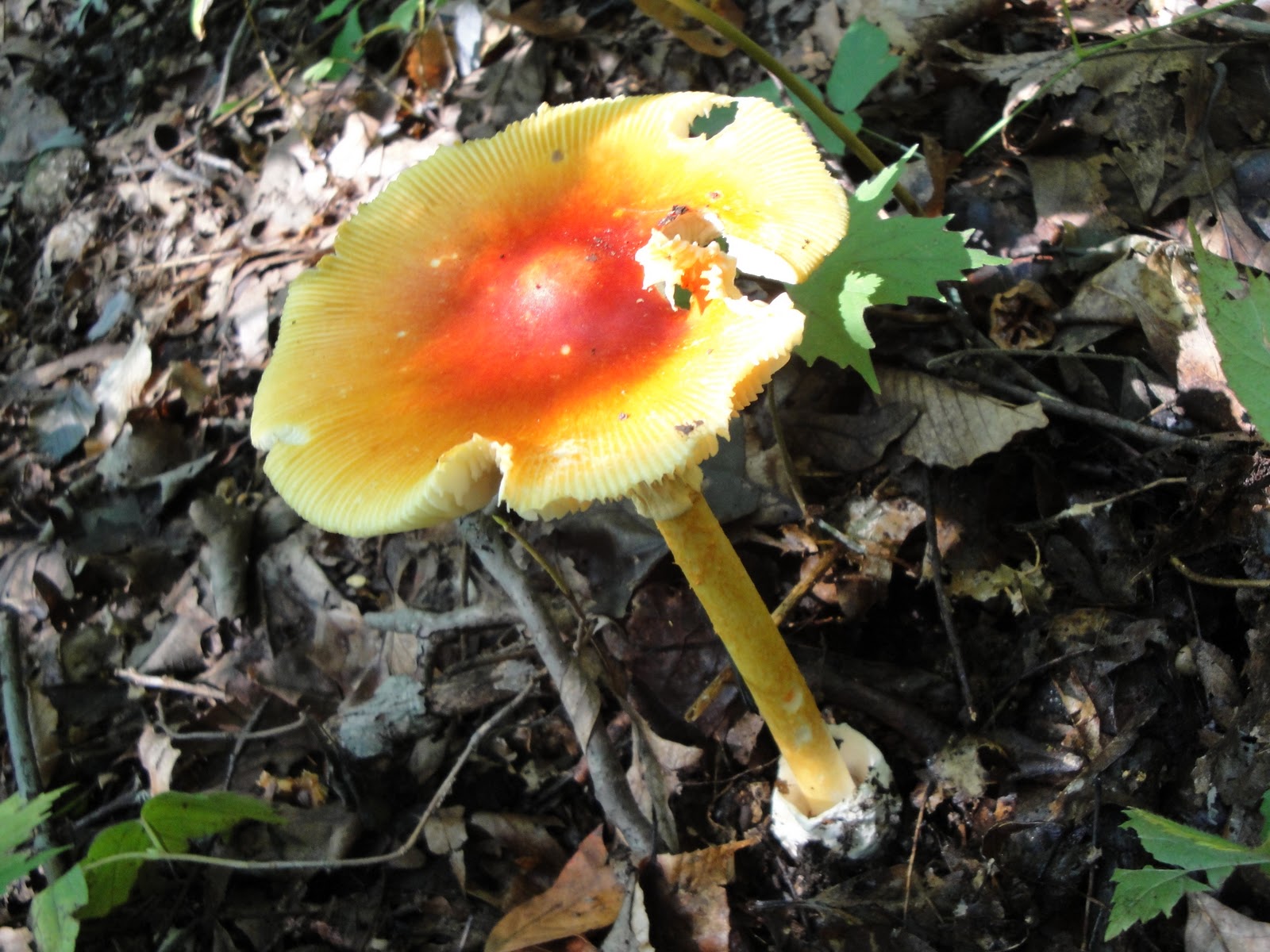
Astute observers with epic memory will note the absence of a "species feature" title and tag to this post, and there's a good reason for that. What reason? The mushrooms I'm talking about might not even be Caesar's mushrooms (Amanita caesarea) at all. The problem is, A. caesarea is notoriously difficult to distinguish from varieties of A. muscaria in this part of the world - specifically var. formosa and var flavivolvata. It's one of nature's cruelest traps - those varieties are both more similar to Caesar's mushroom and more dangerous than their European counterparts. On either side of the pond, A. caesarea is a choice edible. European varieties of A. muscaria, better known as fly agaric, reportedly cause hallucinations, and are sought after for this purpose. However, the U.S. version will just get you violently ill. It's like a ripped off BBC show that way. Michael Kuo (splitter!) has the North American version of Caear's mushroom as A. Jacksonii, a distinction that further confuses things. Kuo is probably technically correct, but for simplicity's sake I will be discussing the species as Amanita caesarea.


This is the nicest specimen of the alleged A. caesarea I have found. It was a lonely giant of its kind in Rock Creek Park earlier this month.

Before proceeding, I must include another mushroom-eating disclaimer. Don't use my blog as your primary resource. Don't eat mushrooms based on my advice. If you use my blog as inspiration to go learn enough to eat wild mushrooms safely, more power to you.

Now for some good news. I believe the similarities between A. caesarea and A. muscaria var. formosa (I can't speak directly to var. flavivolvata, because I've found no specimens of this) are overblown. Mushroom writers are rightly concerned about an amateur making a mistake based upon their descriptions and getting sick or worse. Some of the differences are in superficial or non-persistent characteristics, which are not usually the best aid to getting an accurate mushroom ID. They are both members of the genus that includes species with such common names as "death cap," "destroying angel" and "fool's mushroom." Amanitas account for 95% of mushroom-related fatalities (thanks Wikipedia). All of this leads to understandable caution. (For more on this general topic, see this entry from a fellow local mushroom blogger.) Fortunately for mycophagists, the deadly ones are much, much easier to distinguish from our hero. This leaves a knowledgeable field mycologist with only the risk of illness - and not much risk of that with enough experience.


Amanita muscaria var. formosa, as found in Watkins Regional Park some time ago. Pictures are not the most reliable way to distinguish mushroom species, but taking a close look at these first two photos is a good start.

How these two species are alike:

Both of these mushrooms exhibit classic Amanita features: the spore print is white, they have both universal and partial veils which persist as volvae (please don't confuse this with vulvae) and rings on mature specimens, their gills are free from the stem.  They are also similar in size, habitat, and season. Both are mycorrhizal with hardwoods and with pines. Both have yellow-to-orange coloring on their caps and white flesh. A key to successful mycology, however, is to learn which things are different and isolate them. Of course, one doesn't want to do so to the exclusion of these basic features, but with experience noting the Amanita characteristics will become second nature, and allow one to focus on some other details.

How these two species are different (the key features):

I think the simplest difference to detect is that A. caesarea has yellow gills while A. muscaria has white gills. This isn't a perfect test, because yellow gills can be so pale as to appear white, and white gills can appear yellow beneath a yellow cap in poor lighting. Another helpful difference can be found around their respective volvae. A. caesarea has a much larger, more persistent volva. A. muscaria tends to have shaggy "skin" near the base of the stem where it meets the volva. Caesar's mushroom has a yellowish stem while fly agaric has a white stem (again, the yellow can fade). Finally, A. muscaria not only has, but is famous for, white warts on top of its cap.  A. caesarea lacks these warts. Any one of the four preceding features is not a sure bet - but all four? Solid. I suppose it is remotely possible to find a specimen of A. muscaria whose warts have fallen off, that has an abnormally large volva and lacks a shaggy stem base, and which appears yellowish in the gills and stem. But doesn't that seem like a long shot to you?


Here's a closeup of the volva of Caesar's mushroom.

This shot was meant to demonstrate the yellow stem and gills - but it also inadvertently
demonstrates how it can be hard to tell if the gills are yellow in the field.
 

Luckily I have this old photo - here you can see A. muscaria var. formosa's  white gills, white stem, and smaller volva. You might be able to pick out the shaggy bits at the stembase as well.


Additional apparent differences:


These are why I think the chance of mistaking one of these mushrooms for the other is slim for careful and experienced mycologists. I will admit the possibility that I'm just not experienced enough. Maybe I'm misidentifying everything, and the range of variability within each species is broader than I think. This is why I've yet to eat any Caesar's mushrooms.

The bulk of these differences are in the caps. Look at the photos of the two species.  Don't they seem quite different? A. caesarea is distinctly orange*, shiny, very striated at the margin, lacking in warts, and possessed of a distinct umbo (that's the bump in the middle). by contrast, A. muscaria var. formosa is pale yellow with slight striations at most, many warts, and no umbo. Using these features for IDing a mushroom is a lot like performing a physical task with bad form - positive results are possible, but you're not putting yourself in the best position for achievement. All of those features are variable within each species and can be changed by the environment, given time. And yet, every time I have collected a specimen of either of these species, it has gone this way: I have noted at first glance that it superficially resembles one species or the other. I have taken notes, brought the specimen home, and obtained a white spore print. Upon examining the four key features above I have corroborated my field guess. This has held true for four or five ocurrences of each species. So what I'm saying is that in theory this group of features is not to be used as a definitive identifier, but experimentally they hold up as a reasonable predictor and starting point.

*since these mushrooms are named for a certain Caesar who purportedly had a taste for them, have I discovered the origins of the name "Orange Julius"?


In addition to the links above (mushroomexpert.com, wikipedia, roger's mushrooms, and the free dictionary) I used the following texts as sources: The National Audubon Society's Field Guide to Mushrooms: North America, Simon and Schuster's Guide to Mushrooms, 100 Edible Mushrooms (Michael Kuo), and Field Guid to Wild Mushrooms of Pennsylvania and the Mid-Atlantic (Bill Russell).

7/31/11

Species Feature #9, Ash-Tree Bolete

This feature is long overdue. In many ways the ash-tree bolete (Gyrodon merulioides) should have been Species Feature #1. Without this mushroom, my blog wouldn't exist. It was my first mycology success story: I encountered several specimens growing just outside my apartment. I had no idea what they were, but was able to get a tentative ID from one source. Since I was inexperienced, I really wanted corroboration - so I Googled the scientific name. At the time, one of the first search results took me to a post in this livejournal. It's written by a zoo employee in New England, and it planted the seed that grew into my idea for this blog. My introduction to this DC area blog by Laurel was, I suppose, the fertilizer. But it was my interest in G. merulioides that served as the soil. My blog's synthesis bears remarkable parallels to the ecological niche occupied by this species.

One largish specimen

Gyrodon merulioides Quick Facts

Common Name(s): ash-tree bolete

Taxonomic Breakdown:
  • Kingdom - Fungi
  • Subkingdom - Dikarya
  • Phylum - Basidiomycota
  • Subphylum - Agaricomycotina
  • Class - Agaricomycetes
  • Order - Boletales
  • Family -Paxillaceae
  • Genus - Gyrodon
  • Species - merulioides
Range: I couldn't find information directly on the range of this species, but it is limited to the range of ash trees. Most commonly it is found under white ash, Fraxinus americana.

Just a small sampling of the hundreds of specimens I found one day in Silver Spring

Because of its proximity to white ash, the ash-tree bolete was long thought to be mycorrhizal.This is generally the case when a mushroom species is found exclusively under one species (or in this case, one related group of species) of tree. Yet the life of G. merulioides is more complex than that. It instead participates in a totally different symbiotic relationship - with a species of aphid which itself only feeds on ash trees. Meliarhizophagus fraxinifolii, according to this press release, fights predation by breeding wildly... so wildly, in fact, that some generations are born pregnant. I won't pretend to understand how this happens, but it adds one more layer of fascination to the scene.

Unfortunately, in the 1990s a fourth species entered the picture: the emerald ash borer (Agrilus planipennis), often referred to as simply EAB. This species of beetle decimates populations of ash trees, and threatens the entire genus. I have previously written about invasive species, taking the position that we are often too quick to label introduced species as damaging to their new environments. However, this seems like a clear-cut and very serious problem. Forests in this area can ill afford the loss of yet more tree species, and the EAB threatens several, and no North American species of ash tree has yet shown effective resistance to infestation. Lose the trees, and this biome loses the aphid and the mushroom mentioned above. Lose the aphid, and its predators lose a food source which rapidly replenishes itself.

Collecting spores.


'


This mushroom is easy to identify if one knows what to look for. From above, the irregular, leathery, brown caps can be easy to miss, but once seen these alone are a good indicator of what you're looking at. The stem is lateral and often not very substantial. Underneath, the pore surface is a solid yellow with hexagonal pores. The light yellow (sometimes white) flesh of this bolete, like that of many boletes, bruises blue. A spore print usually isn't necessary for identification, but if taken it will appear olive brown. If you're unsure, look around for ash trees.


Note the blue bruising, and how the pores peel away from the flesh as a discreet layer.

Challenge Complete!

I had to rent some wheels this time - my own bike was out of
commission. A part is on order...
The Naturalism on Speed Challenge is complete! I left for vacation last weekend just two species short of my goal of 100. The five new species I was able to add while cruising Highway 12 on the Outer Banks fell short of my lofty ambitions for the trip (after all, it's a completely different environment) but were more than enough to put me over the top. The new additions are not likely to be seen in the DC suburbs (though I have seen laughing gulls this far inland). While that makes them a little off-topic for the blog they're well within the rules of the challenge. Speaking of rules, I'll recap. The basic premise is to identify species from a moving bicycle. To keep this different from simply identifying wildlife in general, I imposed the following five restrictions:

  1. Listed species must be identified to species while riding, with certainty. 
  2. No unnatural stops are permitted. 
  3. Retroactive identification is also not permitted. 
  4. Domesticated animals (and humans) do not count. 
  5. Plants which grow at my apartment complex or other very familiar areas (my workplace, my parents' house, etc) are ineligible.


Species #99 - Laughing Gull (Leucophaeus atricilla)

Species # 100 - Sea Oats (Uniola paniculata)


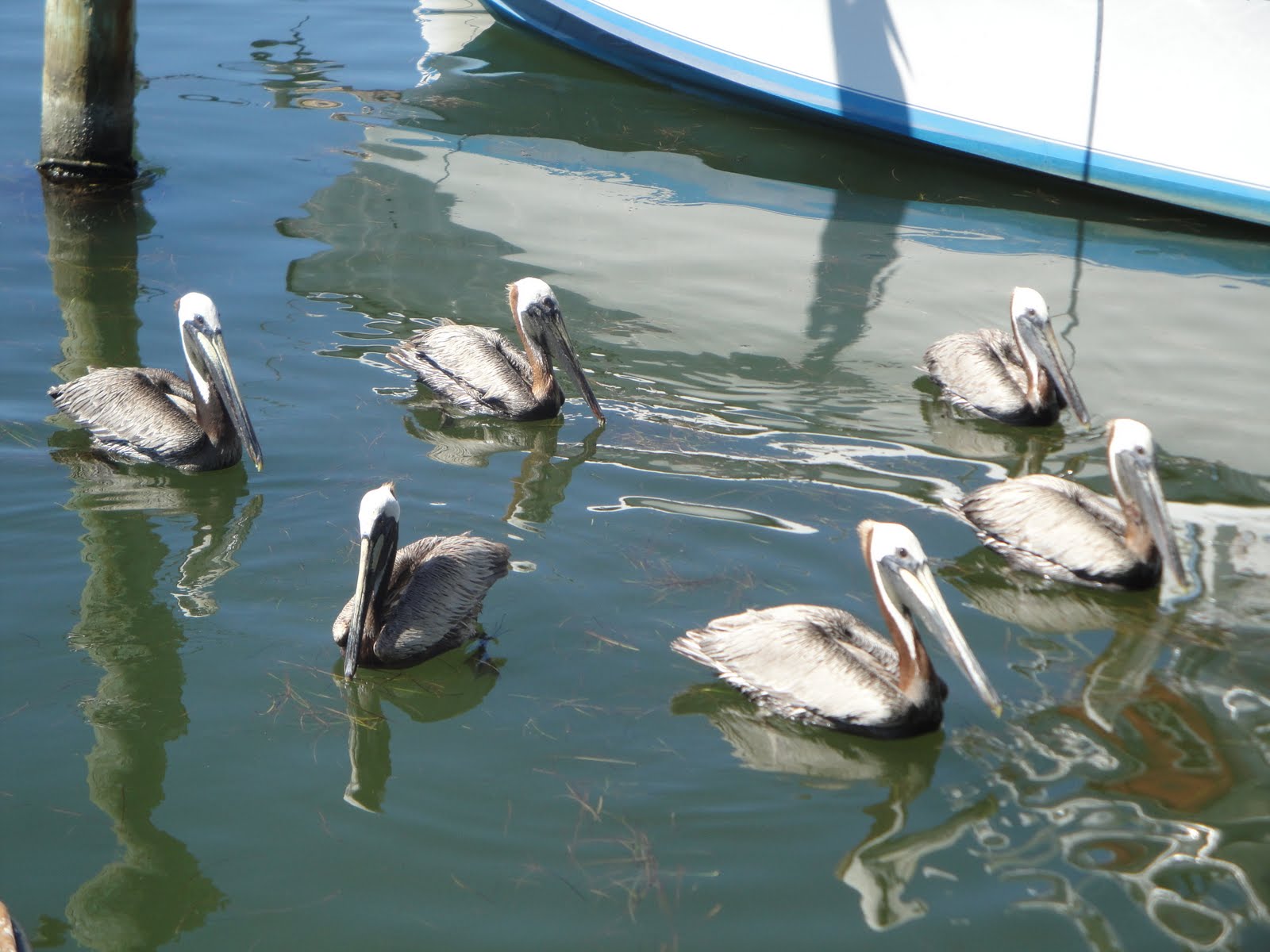
Species # 101 - Brown Pelican (Pelecanus occidentalis)


Species # 102 - Adam's needle (Yucca filamentosa)

 Not pictured: Species # 103 - American beachgrass (Ammophila breviligulata)

This brings me to a final count of 103 species: 58 plants, 23 birds, 11 mammals, 5 fungi, 4 insects, and 2 reptiles. "Final" is a bit of a lie, because I do intend to keep adding to this list as I continue to cycle and to explore the natural world. The marriage of  these two hobbies has been too great an experience to discontinue simply because I reached an arbitrary milestone.

7/17/11

Hike from the New Digs

Most folks reading this already know, but I moved a few weeks ago. It wasn't far, so exploring the neighborhood is really more a matter of seeing the same neighborhood from a slightly different perspective. Still, it's been interesting seeing nature from this new vantage point. I have an altered bike route to work, the grounds of the new apartment are landscaped differently, and the surrounding area is a little more residential. I'm still close to most of the same parks and green spaces, and yet the slight shift in perspective seems to have shaken up my mindset enough that different details stand out.

I noticed this last weekend when taking my first long hike from the new base of operations. It wound through some of the same areas of Rock Creek Park I have blogged about before. I returned up the same section of East-West Highway I used to live on. Yet this hike was different than any previous ones in terms of which living things stood out to me. The next day I took an out-and-back bike ride along Sligo Creek Trail - a ride which allowed me to add about ten new species to my Naturalism on Speed challenge. It's been quite a while since I added more than two or three after a single ride.

A flowering plant along Portal Drive was the first new thing to draw my attention. Its leaves were shaped like a child's drawing of a Christmas tree, and its small flowers ranged from pale violet to white. It had a row of spines along the stem, and these occurred in pairs opposite one another. These spines were also present on the underside of the leaf. (Wow! Typing this paragraph has reminded me just how much plant life review I need if I want to appear knowledgeable. I just don't have the biological vocabulary to be precise.) I've no idea what this plant might be, so if anyone can ID it from the photo below please leave a comment.


Mystery Plant #1.

The next "new" thing I noticed is probably best explained by a picture. It's something I see all the time, but last weekend was the first time I thought it might make a nice photo.


This is a reminder that oyster mushrooms are appetizing to more than just humans. Also, it's hard to tell from this photo but that was one enormous slug.

Mystery plants were a theme of the day. Number two was a ground-covering plant lining much of the trail through the park. I see this plant often but until lat weekend my mind filed it as part of the background, and therefore not an item of interest. It had a long whiplike flower and large leaves relative to the overall plant size. Once I noticed it I saw that it was quite prevalent throughout the northern section of the park. Again, if you have any clue as to this one's identity from the photo below please let me know!


Mystery Plant #2

It was while climbing THE HILL on the way back that I collected my one big mushroom find of the day. This was a large patch of Chlorophyllum molybdites, sometimes known as the green-spored parasol since *dramatic pause* it looks like a parasol mushroom and has green spores. This mushroom is an old friend and among the first handful I learned to reliably identify. The "new" of this encounter was that I hadn't before considered the narrow strip of grass between the main lanes of East-West Highway and the access road as fertile ground for a mushroom search. Looking back, though, these aren't the first mushrooms I've seen there.


Franklin didn't care one bit about the mushrooms, but it sure looks like he's proud of something here, doesn't it?

This brings me to my final mystery plant (well, there was a mystery tree as well but I didn't take any pictures). This plant was enormous for a non-woody plant. It stood easily eight feet high, and likely closer to ten. Its leaves were each larger than my head. I can't really think of any identifying features other than its size, so I'll just show you. If you know what this thing is, you know what to do.


The leaves of Mystery Plant #3
 
  
Mystery Plant #3 in all its monstrous glory.

Coming down the home stretch of the hike, I started seeing a plant I'm familiar with but had never really noticed in Silver Spring: pokeweed. This stuff has berries that start as white flowers which turn green and then a deep, nasty-staining purple. I'm confident enough that the species is American pokeweed (Phytolacca americana) that I counted it in my little challenge when I saw more of it the next day.


Pokeweed in the green (and thus not yet fatal to garments) stage.

I guess the takeaway from last week's experience is that however familiar I think I am with the natural environment, there's always something there I hadn't noticed before. Whether my move had anything to do with my shift in perception is immaterial - what matters is that the diversity of life is great enough to continually provide new surprises.