Showing posts with label Washington DC. Show all posts

3/20/12

Back in the Saddle

I don't think fierce pedaling would be enough to escape that fellow... 

With the return of Spring (which is now official, if specious) comes the return of cycling. While I have been riding to work intermittently since the end of January, this weekend marked my first ride longer than that. That ride served as a reminder of just how awesome it is to live in the DC suburbs and own a bike capable of handling varied terrain. My route took me through urban streets in Silver Spring, down Beach Drive (closed to motorists on weekends), past (and into) the National Zoo, onto the National Mall, along the C&O Canal Towpath, and back to Silver Spring on a paved bike trail. All of this was less than a 30-mile ride.

Boulder Bridge in Rock Creek Park is one of my favorite cycling landmarks.
 
So what does a new season of cycling mean? Well, I'm doing another century ride, or the same one over again if you prefer something that sounds more zen. The CASA River Century was a lot of fun and training for it was good for me, good for the environment, and good for traffic between Silver Spring and Rockville. Dustin and I will be joined by a third rider this year, and hopefully this time it serves as a prelude to the Sea Gull Century. Other life events might make this difficult, but I think I'll be able to make it happen.

The new season also means a new Naturalism on Speed challenge for me, which may bore the bajeezus out of my readers. Even if it does, it will at the very least hone my knowledge and skills, which in turn will make me better at this*. I'm aiming for fifty new species to add to last year's final total (which will make 153 the magic number). Sunday's ride netted me five or six to get started with. A quick recap of the rules:
  1. I have to ID each species positively.
  2. I can't stop for a better look, but I can count what I see when I'm already stopped.
  3. I must know what I'm seeing when I see it - research can only help for next time.
  4. Domesticated animals and people don't count, nor do plants in planters/gardens.
  5. I can't count specimens I see all the time and thus have the chance to study thoroughly.

The sights in DC are iconic and worthwhile - and with a bike you can take in a huge number of them in just a few hours.


I'll close by reminding everyone how bike-friendly the Washington, DC area is. The Capital Bikeshare program is awesome, and there is an extensive network of trail systems. I could conceivably ride (about 90 miles) from my apartment to my parents' house just outside of Martinsbug, WV. The Metro makes it easy to close little gaps in your ride by hopping a train for a stop or two (except during weekday rush hour). The buses are theoretically all equipped to handle your bicycle.


*That's my polite way of saying "deal with it."

2/29/12

12 Months of Nature: February

Like February (that most dismal of months) itself, the February section of  Seasonal Guide to the Natural Year was generally short and forbidding. When conceiving this project, I had expected some months to be easier than others, and even expected to fail spectacularly at achieving the aim of my journey once or twice. But after reading my options for February, I despaired of even being able to put together a trip worthy of this blog... would "12 months of nature" become "11 out of 12 months of nature" so soon?

Option 1, "Winter Hawks" sounded promising until I discovered that all of the recommended spots were prohibitively far away. Option 2, "Tracking" seemed a little too general and unexciting for my purposes. Options 3 and 4 were titled "Lake Eerie Steelhead,"  and "Exploring Winter Beaches," respectively - both of which were also out because of travel time. The final option, "Pelagic Birding Trips," sounded fascinating but requires much more organization than I had the time or inclination to put together. Frankly, I had to look up the word 'pelagic' anyway.


February Event: Tracking

My choice of a human footprint here doesn't mean
I failed entirely...
So, I chose "Tracking" from the list above. I could have instead resigned myself to traveling a greater distance than I wanted to with a good chance of not seeing the hawks or steelhead I sought. The payoff might have been far more interesting. But the conservative approach meant that it would be hard to fail. One of my favorite places, Shenandoah National Park, was a recommended destination. There was the possibility of snow, which would only make track identification easier, in theory. Besides, the point of tracking isn't necessarily to find fauna itself, but to understand and interpret signs of its presence and impact on the environment.


The Location

I have repeatedly talked about this place, and I'm sure it will come up over and over again in this blog. So I won't bore you with redundancies (except in link form). Looking back, though, it's hard to believe I only have one post solely about Shenandoah.

Why there, and Why then?

Well, the guide was right about one thing. There was definitely snow.
The answer to "why there" was sort of unclear... really, one can track anywhere outside. Animals walk, poop, eat, and so forth everywhere. I think the guide suggested Shenandoah primarily because there is a ton of open space, and because wildlife traffic is a lot higher than most places in this region of the US. I had an ulterior motive for going to the park that most of my readers are aware of. So "why then," then? Well, I think they stuck "tracking" in February primarily because it was the toughest month to fill out with reasonable activities, but also because of the likelihood of snow.


The Trip, and What I Learned

Like the previous trip, this one was wonderful. Unfortunately I didn't learn much about tracking - I relied on a few things I already know and just enjoyed getting a good hike in in February. We got to the park pretty early, and chose one of our favorite spots: Mary's Rock. (There are those ulterior motives again). The last time we had done this hike was in the hottest part of the summer, so it was a nice change of pace (and still gorgeous) to hike it with a dusting of snow. What's nice about this hike is that although steep, it's less than a two-mile trip from the parking lot to the summit. And the view is spectacular.

The trailhead - per the sign, much of this hike is on the Appalachian Trail.

We thought this was beautiful - a veritable explosion of color amid the white, gray, and brown.

I have a couple of decent photos of the view from Mary's Rock itself, but I don't feel they do it justice. If you follow the link above there are a couple that almost get the job done, but it's one of those things you just have to see to appreciate fully. Luckily for DC denizens, it's not too far away and you don't have to be a marathon runner to pull off the climb.

When we were finished with that hike, we decided to make a quick stop at one of the park's other notable spots, Big Meadows. As usual, there were quite a few deer nearby (and signs of other fauna, which I'll get to). I have to say, though, that Big Meadows is pretty drab in the dead of winter. There's still a certain beauty to the place, and I'm glad I have seen it in its more dormant state, but I wouldn't put it at the top of my list for winter outings.
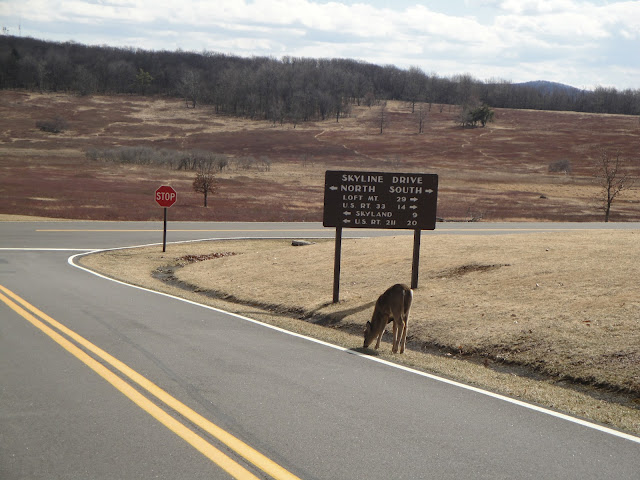
Big Meadows and one of the creatures it is famed for. As a nerd about such things, it has often bothered me that "Big Meadows" is a singular proper noun for a place composed of plural meadows. But I digress (as usual).


My guess is these were left by a squirrel. But it's hard to be
certain without a clear footprint.
 You don't even have to be an astute reader to wonder where the bit about tracking is, since that was after all the point of the exercise. Well, to be frank, we didn't find a lot of identifiable tracks, even in the snow. I think the amount of snow was such that it made it harder rather than easier - just enough to cover any visible tracks but not enough to leave good tracks. Also, the ground was still frozen. Any place where deer or some other large animal had clearly been was mostly torn up into a tangled mess. The clearest tracks were those left by fellow hikers and their canines. However, as you'll see below, footprints aren't the only signs one can use as clues to animal activity.


Deer poop
 I apologize for this next photo, but one just can't talk with any reasonable credibility about tracking without briefly discussing poop. It just can't be done. The scat at right belongs to white-tailed deer, although on this trip we also saw quite a bit of carnivores' waste as well. It could have been from foxes, coyotes, bobcats, or possibly just family pets. There was a lot of high fur content, though (you can tell just by glancing) so my guess is "coyote." In the past there was an unfortunate incident involving Franklin and some bear feces, but I don't want to talk about it. So end my scatological ramblings for the day.


A couple of other signs of note were some loose feathers, and some obvious groundhog trails. Photos of those are even more boring than photos of poop, though, so I'll let it go.

When tracking, what a good naturalist is really after is not just  an identity of what had passed this way, but a story of what it was doing and why. If the deer tracks are clustered in one muddy spot, what made them behave this way? Was it a predator? A mating display or fight for dominance? If there's loose fur, did the owner just get snagged on a twig or was there some sort of conflict? How recent are the tracks you're looking at? Was the animal moving quickly or slowly? One thing I noticed was that some of the deer scat was clustered into piles, while other spots were scattered. This led me to wonder why those particular deer were exhibiting divergent restroom behaviors. It's this type of question that can turn one from aware of nature's signs to an expert at interpreting them. Myself, I'm somewhere in between... I know how to ask the questions but not often how to answer them. Good guides on tracking do exist, though I can't offer much in the way of critique. If you're interested in learning how to track and "read sign" I suggest that you research these and select one... but it's really the experience that will teach you. I will leave you with my favorite deer picture from the day.

This young buck is showing his antler velvet... I've never managed a clear photo of this before, so I'll call it a win.

2/23/12

Further Evidence of Spring

This is more of a follow-up than its own post. I don't have a ton of new thoughts to share, but since I wrote yesterday about the signs that spring is upon us I have been hyperaware of anything that could constitute such a sign. I've been looking for them. I continue to be surprised by them. This could be thought of as a validation post (see! I'm not crazy!) There may also be an element of wishful thinking: Spring! morels! biking! BEING OUTSIDE! Laying all that aside, I'll just present some snapshots (all taken today). I'm not going to try to identify what I don't know, or go into detail about what I do know. So please, just look at the pretty things.

In this out-of-focus photo, you can see that some of the topiary at Rock Creek Springs is budding. This appears to be something related to holly, but how closely I don't know.

I don't believe these red berries usually start appearing for a few weeks.

Apparently not only are dandelions already growing, but some have even gone to seed!


Some very pretty blue flowers are also showing themselves.

Crocuses?

I saw these and thought "wow, the daffodils already have buds!" So imagine my surprise...


...when I saw these! Yes, I saved the best for last.
I know this has all been plant-based evidence of Spring. I had hoped to steal a picture or two of some of the robins and other returning birds I've been seeing, but either they weren't cooperating or I was too lazy. I was also both too early and too late to catch the bees in action today.

9/26/11

Caesar's Mushroom

First off: wow! Busy summer. It was busy in a very positive way, but that did lead to two things 1) fewer outdoor excursions and 2) less time to post about them. But I have not abandoned this blog (for entirely selfish reasons; it's a lot of fun and strokes the old ego a bit). Luckily for me, it rained a lot in August/September and thus the mushrooming improved quite a bit. As such, I've accumulated a backlog of images and information to share here.

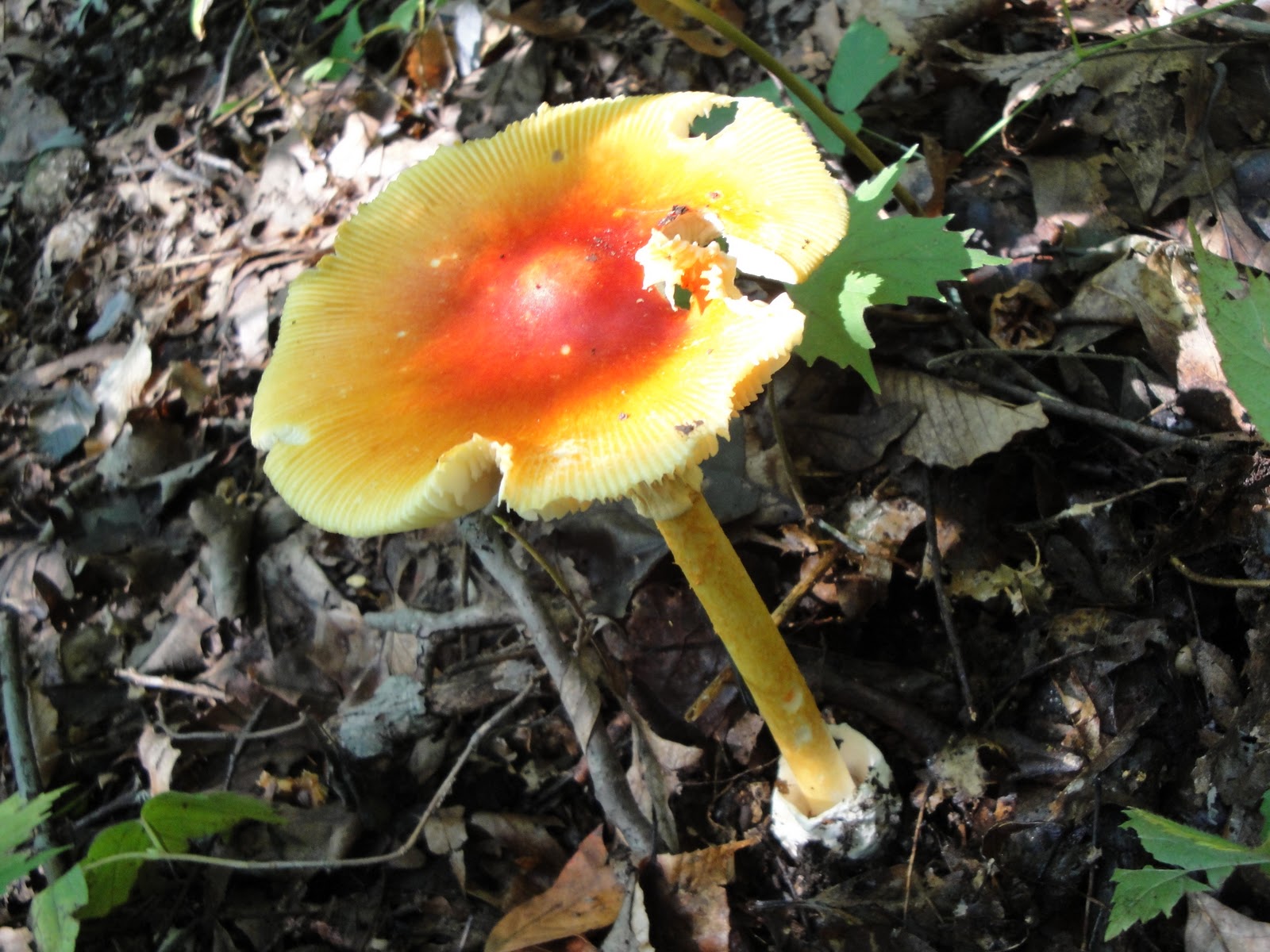
Astute observers with epic memory will note the absence of a "species feature" title and tag to this post, and there's a good reason for that. What reason? The mushrooms I'm talking about might not even be Caesar's mushrooms (Amanita caesarea) at all. The problem is, A. caesarea is notoriously difficult to distinguish from varieties of A. muscaria in this part of the world - specifically var. formosa and var flavivolvata. It's one of nature's cruelest traps - those varieties are both more similar to Caesar's mushroom and more dangerous than their European counterparts. On either side of the pond, A. caesarea is a choice edible. European varieties of A. muscaria, better known as fly agaric, reportedly cause hallucinations, and are sought after for this purpose. However, the U.S. version will just get you violently ill. It's like a ripped off BBC show that way. Michael Kuo (splitter!) has the North American version of Caear's mushroom as A. Jacksonii, a distinction that further confuses things. Kuo is probably technically correct, but for simplicity's sake I will be discussing the species as Amanita caesarea.


This is the nicest specimen of the alleged A. caesarea I have found. It was a lonely giant of its kind in Rock Creek Park earlier this month.

Before proceeding, I must include another mushroom-eating disclaimer. Don't use my blog as your primary resource. Don't eat mushrooms based on my advice. If you use my blog as inspiration to go learn enough to eat wild mushrooms safely, more power to you.

Now for some good news. I believe the similarities between A. caesarea and A. muscaria var. formosa (I can't speak directly to var. flavivolvata, because I've found no specimens of this) are overblown. Mushroom writers are rightly concerned about an amateur making a mistake based upon their descriptions and getting sick or worse. Some of the differences are in superficial or non-persistent characteristics, which are not usually the best aid to getting an accurate mushroom ID. They are both members of the genus that includes species with such common names as "death cap," "destroying angel" and "fool's mushroom." Amanitas account for 95% of mushroom-related fatalities (thanks Wikipedia). All of this leads to understandable caution. (For more on this general topic, see this entry from a fellow local mushroom blogger.) Fortunately for mycophagists, the deadly ones are much, much easier to distinguish from our hero. This leaves a knowledgeable field mycologist with only the risk of illness - and not much risk of that with enough experience.


Amanita muscaria var. formosa, as found in Watkins Regional Park some time ago. Pictures are not the most reliable way to distinguish mushroom species, but taking a close look at these first two photos is a good start.

How these two species are alike:

Both of these mushrooms exhibit classic Amanita features: the spore print is white, they have both universal and partial veils which persist as volvae (please don't confuse this with vulvae) and rings on mature specimens, their gills are free from the stem.  They are also similar in size, habitat, and season. Both are mycorrhizal with hardwoods and with pines. Both have yellow-to-orange coloring on their caps and white flesh. A key to successful mycology, however, is to learn which things are different and isolate them. Of course, one doesn't want to do so to the exclusion of these basic features, but with experience noting the Amanita characteristics will become second nature, and allow one to focus on some other details.

How these two species are different (the key features):

I think the simplest difference to detect is that A. caesarea has yellow gills while A. muscaria has white gills. This isn't a perfect test, because yellow gills can be so pale as to appear white, and white gills can appear yellow beneath a yellow cap in poor lighting. Another helpful difference can be found around their respective volvae. A. caesarea has a much larger, more persistent volva. A. muscaria tends to have shaggy "skin" near the base of the stem where it meets the volva. Caesar's mushroom has a yellowish stem while fly agaric has a white stem (again, the yellow can fade). Finally, A. muscaria not only has, but is famous for, white warts on top of its cap.  A. caesarea lacks these warts. Any one of the four preceding features is not a sure bet - but all four? Solid. I suppose it is remotely possible to find a specimen of A. muscaria whose warts have fallen off, that has an abnormally large volva and lacks a shaggy stem base, and which appears yellowish in the gills and stem. But doesn't that seem like a long shot to you?


Here's a closeup of the volva of Caesar's mushroom.

This shot was meant to demonstrate the yellow stem and gills - but it also inadvertently
demonstrates how it can be hard to tell if the gills are yellow in the field.
 

Luckily I have this old photo - here you can see A. muscaria var. formosa's  white gills, white stem, and smaller volva. You might be able to pick out the shaggy bits at the stembase as well.


Additional apparent differences:


These are why I think the chance of mistaking one of these mushrooms for the other is slim for careful and experienced mycologists. I will admit the possibility that I'm just not experienced enough. Maybe I'm misidentifying everything, and the range of variability within each species is broader than I think. This is why I've yet to eat any Caesar's mushrooms.

The bulk of these differences are in the caps. Look at the photos of the two species.  Don't they seem quite different? A. caesarea is distinctly orange*, shiny, very striated at the margin, lacking in warts, and possessed of a distinct umbo (that's the bump in the middle). by contrast, A. muscaria var. formosa is pale yellow with slight striations at most, many warts, and no umbo. Using these features for IDing a mushroom is a lot like performing a physical task with bad form - positive results are possible, but you're not putting yourself in the best position for achievement. All of those features are variable within each species and can be changed by the environment, given time. And yet, every time I have collected a specimen of either of these species, it has gone this way: I have noted at first glance that it superficially resembles one species or the other. I have taken notes, brought the specimen home, and obtained a white spore print. Upon examining the four key features above I have corroborated my field guess. This has held true for four or five ocurrences of each species. So what I'm saying is that in theory this group of features is not to be used as a definitive identifier, but experimentally they hold up as a reasonable predictor and starting point.

*since these mushrooms are named for a certain Caesar who purportedly had a taste for them, have I discovered the origins of the name "Orange Julius"?


In addition to the links above (mushroomexpert.com, wikipedia, roger's mushrooms, and the free dictionary) I used the following texts as sources: The National Audubon Society's Field Guide to Mushrooms: North America, Simon and Schuster's Guide to Mushrooms, 100 Edible Mushrooms (Michael Kuo), and Field Guid to Wild Mushrooms of Pennsylvania and the Mid-Atlantic (Bill Russell).

7/31/11

Challenge Complete!

I had to rent some wheels this time - my own bike was out of
commission. A part is on order...
The Naturalism on Speed Challenge is complete! I left for vacation last weekend just two species short of my goal of 100. The five new species I was able to add while cruising Highway 12 on the Outer Banks fell short of my lofty ambitions for the trip (after all, it's a completely different environment) but were more than enough to put me over the top. The new additions are not likely to be seen in the DC suburbs (though I have seen laughing gulls this far inland). While that makes them a little off-topic for the blog they're well within the rules of the challenge. Speaking of rules, I'll recap. The basic premise is to identify species from a moving bicycle. To keep this different from simply identifying wildlife in general, I imposed the following five restrictions:

  1. Listed species must be identified to species while riding, with certainty. 
  2. No unnatural stops are permitted. 
  3. Retroactive identification is also not permitted. 
  4. Domesticated animals (and humans) do not count. 
  5. Plants which grow at my apartment complex or other very familiar areas (my workplace, my parents' house, etc) are ineligible.


Species #99 - Laughing Gull (Leucophaeus atricilla)

Species # 100 - Sea Oats (Uniola paniculata)


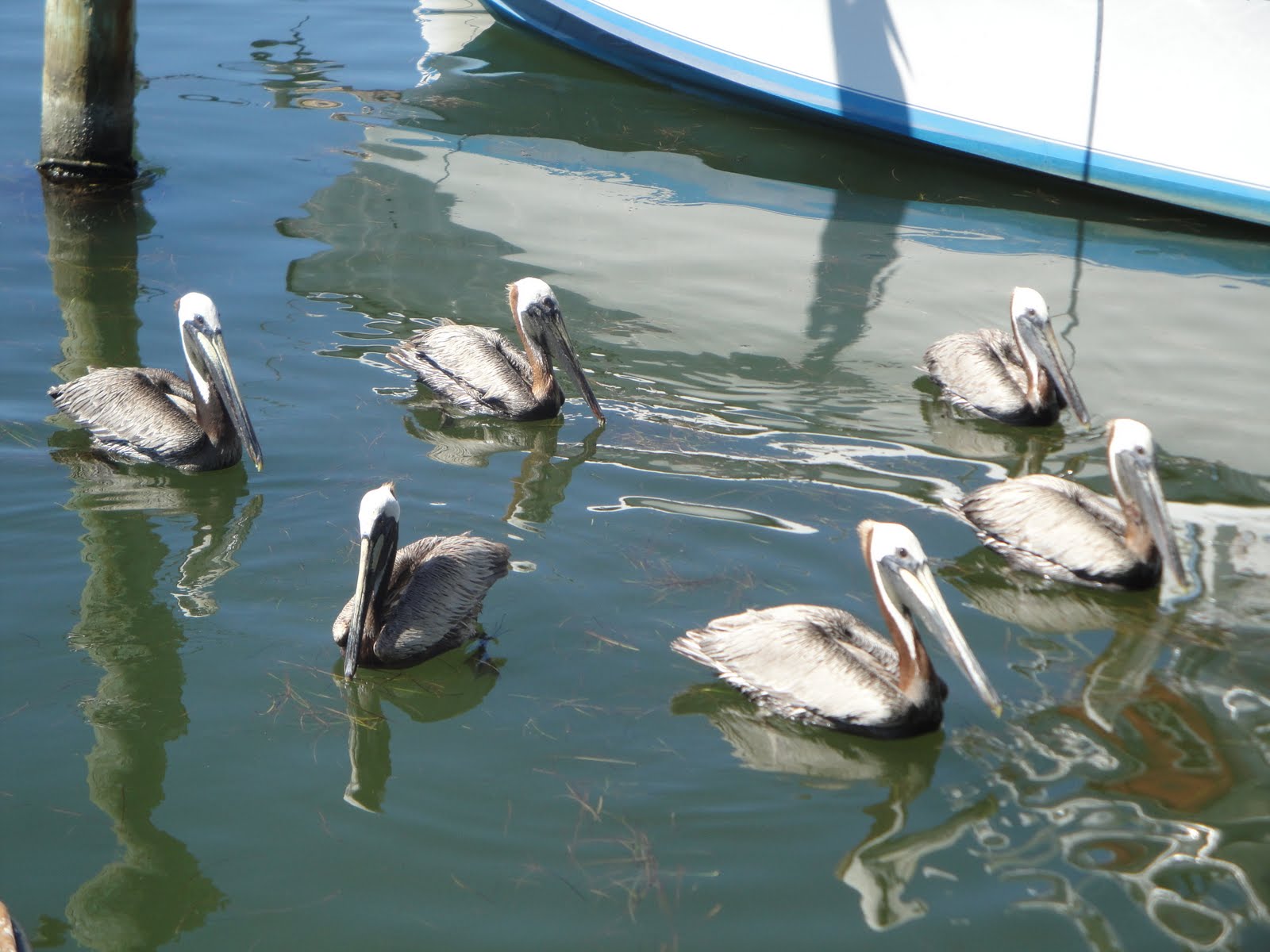
Species # 101 - Brown Pelican (Pelecanus occidentalis)


Species # 102 - Adam's needle (Yucca filamentosa)

 Not pictured: Species # 103 - American beachgrass (Ammophila breviligulata)

This brings me to a final count of 103 species: 58 plants, 23 birds, 11 mammals, 5 fungi, 4 insects, and 2 reptiles. "Final" is a bit of a lie, because I do intend to keep adding to this list as I continue to cycle and to explore the natural world. The marriage of  these two hobbies has been too great an experience to discontinue simply because I reached an arbitrary milestone.

7/17/11

Hike from the New Digs

Most folks reading this already know, but I moved a few weeks ago. It wasn't far, so exploring the neighborhood is really more a matter of seeing the same neighborhood from a slightly different perspective. Still, it's been interesting seeing nature from this new vantage point. I have an altered bike route to work, the grounds of the new apartment are landscaped differently, and the surrounding area is a little more residential. I'm still close to most of the same parks and green spaces, and yet the slight shift in perspective seems to have shaken up my mindset enough that different details stand out.

I noticed this last weekend when taking my first long hike from the new base of operations. It wound through some of the same areas of Rock Creek Park I have blogged about before. I returned up the same section of East-West Highway I used to live on. Yet this hike was different than any previous ones in terms of which living things stood out to me. The next day I took an out-and-back bike ride along Sligo Creek Trail - a ride which allowed me to add about ten new species to my Naturalism on Speed challenge. It's been quite a while since I added more than two or three after a single ride.

A flowering plant along Portal Drive was the first new thing to draw my attention. Its leaves were shaped like a child's drawing of a Christmas tree, and its small flowers ranged from pale violet to white. It had a row of spines along the stem, and these occurred in pairs opposite one another. These spines were also present on the underside of the leaf. (Wow! Typing this paragraph has reminded me just how much plant life review I need if I want to appear knowledgeable. I just don't have the biological vocabulary to be precise.) I've no idea what this plant might be, so if anyone can ID it from the photo below please leave a comment.


Mystery Plant #1.

The next "new" thing I noticed is probably best explained by a picture. It's something I see all the time, but last weekend was the first time I thought it might make a nice photo.


This is a reminder that oyster mushrooms are appetizing to more than just humans. Also, it's hard to tell from this photo but that was one enormous slug.

Mystery plants were a theme of the day. Number two was a ground-covering plant lining much of the trail through the park. I see this plant often but until lat weekend my mind filed it as part of the background, and therefore not an item of interest. It had a long whiplike flower and large leaves relative to the overall plant size. Once I noticed it I saw that it was quite prevalent throughout the northern section of the park. Again, if you have any clue as to this one's identity from the photo below please let me know!


Mystery Plant #2

It was while climbing THE HILL on the way back that I collected my one big mushroom find of the day. This was a large patch of Chlorophyllum molybdites, sometimes known as the green-spored parasol since *dramatic pause* it looks like a parasol mushroom and has green spores. This mushroom is an old friend and among the first handful I learned to reliably identify. The "new" of this encounter was that I hadn't before considered the narrow strip of grass between the main lanes of East-West Highway and the access road as fertile ground for a mushroom search. Looking back, though, these aren't the first mushrooms I've seen there.


Franklin didn't care one bit about the mushrooms, but it sure looks like he's proud of something here, doesn't it?

This brings me to my final mystery plant (well, there was a mystery tree as well but I didn't take any pictures). This plant was enormous for a non-woody plant. It stood easily eight feet high, and likely closer to ten. Its leaves were each larger than my head. I can't really think of any identifying features other than its size, so I'll just show you. If you know what this thing is, you know what to do.


The leaves of Mystery Plant #3
 
  
Mystery Plant #3 in all its monstrous glory.

Coming down the home stretch of the hike, I started seeing a plant I'm familiar with but had never really noticed in Silver Spring: pokeweed. This stuff has berries that start as white flowers which turn green and then a deep, nasty-staining purple. I'm confident enough that the species is American pokeweed (Phytolacca americana) that I counted it in my little challenge when I saw more of it the next day.


Pokeweed in the green (and thus not yet fatal to garments) stage.

I guess the takeaway from last week's experience is that however familiar I think I am with the natural environment, there's always something there I hadn't noticed before. Whether my move had anything to do with my shift in perception is immaterial - what matters is that the diversity of life is great enough to continually provide new surprises.

6/18/11

Invasive Species

Let me preface this by saying: I am not a biologist, and therefore not qualified to truly debate the issue of invasive species. Nor should the thoughts which follow be taken as an indictment on the field of biology or any of its scholars. I'm certain that the central question I wish to raise has been thought of and discussed in those circles. (In fact, I know some research has been done.) What I am uncertain of, however, is if a satisfactory conclusion has been reached. My question: are invasive species always bad?

This question is pretty simple in terms of syntax, and yet my research into this has suggested that it is complex and even difficult to asses as a valid question. The first problem is that the term "invasive species" has a fluid meaning. It is sometimes defined as a "non-native species with an adverse effect on the habitat it is invading." Adherents of that definition of the term would say "yes," and the discussion would end. At the other end of the spectrum, the term is synonymous with "introduced species," broadening its horizons to include all non-native species. Under this definition, I think it would be safe to say "no" to my original question and move on... after all, the apple is an introduced species, and I don't think anyone is blaming it directly for any particular problems (if I'm wrong about this, I'm certain there is another example - perhaps the tomato).

The above, infuriatingly, gets us nowhere: we have an absolute question with a simultaneous yes and no answer (yuck!). So how do we move past the semantics here? The first definition above is the more widely used, so I will use that as "the" definition for the purposes of this discussion. To avoid the dead-end in the debate, I must rephrase the question as follows: do biologists and/or naturalists too readily classify a species as invasive? The crux of this question is whether or not we have enough data and understanding of our ecosystem to accurately evaluate harm.

I don't have an answer to that question; I do have suspicions that naturalists are generally predisposed to see any change as negative. That predisposition, I suspect, leads us to view any effect of an introduced species as a negative effect. I'm going to attempt to share my thought process as it occurred to me: through a series of examples encountered in my own life over the past year or so.


Mile-a-minute and its distinctive triangular leaves and red
vine. The plant produces small, blue-to-purple berries.
Last summer, I put in some volunteer hours removing invasive species with the Friends of Sligo Creek. There were several such species marked for destruction, but the hardy mile-a-minute stands out in my mind. This stuff earns its name. Its vines snaked through an entire field, choking off other flora to a staggering degree. It climbed bushes and trees, out-competing not only the other ground cover but the taller flora as well. This seems like a clear-cut case of an invasive species which is truly bad for its environment. In this environment, mile-a-minute thrives so well that it threatens every other plant, endangering food sources and habitats for the area's fauna. There's no one species it is in competition with - it risks a severe drop in the biodiversity in the local area.


This is mile-a-minute doing what it does.

I've been hearing a lot about deer exclosures lately. These are tall fences put in place to exclude deer from a small area. The vegetation inside and outside the exclosure is later studied comparatively. On the surface, this would seem tangential to the subject of invasive species - the white-tailed deer is an example of a native species which has become a problem. However, per NPR reports on these studies in Silver Spring (Sligo Creek again) one of the more striking differences between the vegetation growth on either side of the fence involves the success of native vs. introduced species. Where deer are free to roam, they decimate populations of native species, while leaving the invasive species alone. Looked at in one light, this means that the native plants are under attack on two fronts. However, without the non-native plants, would the deer simply consume ALL of the area's vegetation? In this interaction, I wonder if perhaps the introduced plants are in fact acting to preserve the biodiversity of suburban wooded areas in the region. I don't know, but it seems a question worth asking.


This red mulberry grows near my apartment. As I will explain below, it may actually be a hybrid with the introduced white mulberry. One cannot really tell without a DNA study of the specimen these days.

It was some new information about mulberries that finally inspired me to write on this topic. I learned that the native red mulberry (Morus rubra) is often hybridizing with the invasive white mulberry (Morus alba). When I first read of this, it was presented as a sinister attack on the genetic purity of M. rubra. Yet the more I read the less I understood why this is a problem. Both species occupy the same niche, and the hybrids produce viable offspring. I'm sure the rationale is that if one species eliminates the other it would constitute a decrease in biodiversity. But would it? If two closely-related species interbreed to become one with a greater range of genetic variability, isn't that positive? Doesn't a larger gene pool mean a more robust population? The line between species is arbitrary in the first place - it is sometimes even loosely defined by the ability to produce viable offspring, which calls into question whether these are two species or one with a broad genetic base. At its best, the idea that M. rubra is somehow threatened in this interaction seems analogous to dog breeders' aversion to mutts, or to the concept of preserving a royal line through inbreeding.

There is a range of ambiguity in the examples above. The first seems a clear-cut case of a correctly identified invasive species. The second seems nothing but gray area to me. Clearly the overpopulated deer are damaging the ecosystem, but are the introduced species truly invasive in this case, or will they have a net positive effect given the destruction already wrought? The third seems a very likely candidate for just the type of mistake I suspect happens. I certainly could be missing a key point there, so I don't mean to imply that I have answered my question... I cite it instead as evidence that my question is valid. Is M. alba truly "invasive" under the strictest definition of the term?

It is certainly a tricky - and even uncomfortable - question. Where is the line between healthy competition and destructive contaminant? How do conservationists act without a complete answer to this question? I don't wish to sound pessimistic, or to frighten anyone into inaction. I do hope, though, that readers will think on these matters when they act to preserve the natural environment.

6/12/11

Species Feature #8, Train Wrecker

The train wrecker is a fascinating mushroom, technically an edible but not particularly palatable. I'll get the story of its common name out of the way quickly rather than keep you in suspense. This mushroom has reportedly decayed railroad ties to such a degree that accidents have resulted. These stories, however, may be apocryphal - after all, a number of other organisms were undoubtedly at work on each of the ties in question. Mature specimens can be quite large and showy, and their brown scales, jagged gills and inrolled cap margins can give them a rustic appearance. The stems, too, contribute to this rugged feeling with their often shaggy rings and reddish-brown scales. The size makes this mushroom a tempting kitchen experiment, but it has a tough, leathery texture which prevents it from being truly appetizing.


An immature specimen harvested from a decaying stump. Note the gills' attachment to the stem, and their already ragged nature. The scales on the stem are also readily apparent.

Neolentinus lepideus Quick Facts

Common Name(s): train wrecker, scaly lentinus

Taxonomic Breakdown:

  • Kingdom - Fungi
  • Subkingdom - Dikarya
  • Phylum - Basidiomycota
  • Subphylum - Agaricomycotina
  • Class - Agaricomycetes
  • Order - Gloeophyllales
  • Family -Gloeophyllaceae
  • Genus - Neolentinus
  • Species - lepideus

The genus of this mushroom used to be Lentinus, but as with many fungi these days this has recently changed.

Range:  This mushroom is common throughout North America and Europe. It can be found growing on decaying coniferous wood and occasionally on hardwood as well. It has even been reported in coal mines.


A mature specimen, with a bit of substrate (the thing it grows on and consumes) brought along for good measure.

Here is a closeup of the gills and cap margin in a mature specimen. This one was found deep in Rock Creek Park alongside a picnic table.

It is not recommended to eat this mushroom if collected growing from treated wood - unpleasant substances like the chemicals used for weatherproofing can be taken up in the fruiting body as it grows. I personally don't recommend eating this at all due to its general mediocrity. In Michal Kuo's 100 Edible Mushrooms, Darvin DeShazer quotes another mycophagist, Robert Mackler, thusly: "If it's not at least as good as a portobello, why eat it?" I don't agree fully with this fourth-hand thought (the answer is "because it's cool," or maybe "to find out what it tastes like," etc.). However, having tasted this species I am inclined to agree in this instance. Of course, it isn't recommended to eat ANY wild mushroom at all without extensive knowledge and experience... so keep that in mind as well. If you see a mushroom that looks like the above, the reward side of the risk-reward balance is very small.

6/8/11

It's Hot (A Cautionary Post)

It's summer! Don't give me this Summer Solstice crap, here in the DC area we know better. Early June, and we're flirting with trip-digits out there. If you're new to the area and reading this, you are hereby warned: over the next three months, you will be seeing this. Often. Wait, though... why am I griping about the heat on a blog about naturalism? Well, apart from the obvious fact that most of naturalism happens outside (you know, where all that heat is) hydration is a matter of tremendous importance for anyone doing anything outside in heat like this.


You may think (and you'd be right) that hiking or strolling is a lot less strenuous on your body than playing sports, running, "working out," etc. However, one is also less likely to notice when one is becoming dehydrated during this lower-impact activity. My goal today is to convince anyone reading this to consider hydration - and to take it very seriously - when doing whatever it is you do in nature. Much of this is common sense, but it is good practice to occasionally sit and think about common sense. Why is it common, and why is it sense?


Hydration begins before you do.

What do I mean by that load of BS? You need to be hydrated before you go outside and start your activity. Did you have three cups of coffee this morning? If so, you'd better down a glass or two of water before you get going. Whatever your morning diet, you should really consider drinking a significant volume of water before you leave the comfort of your A/C.

Take more than you think you need.

No translation needed for this one. Whatever your estimate of water needs, bring more. If you're driving somewhere, leave excess in the car. If you don't think you can carry it, find a way. Make room.

Plan your refills.

If your trip is long, make sure you begin it with an idea of where and when you will encounter fresh water sources. Then, take advantage of them. Even if you're "ahead of the curve" it doesn't hurt to top off your supply. You may want to consider purification tables if you're depending on streams, springs, etc.

Sip, don't guzzle.

If you don't listen to this one, you will learn why.

Over-hydration can happen...

...but it generally doesn't. It takes something extreme. If you're worried about it, bring some electrolytes with you (in whatever form you choose). Again, this is rare but needed to be mentioned.

If you feel dehydrated, it's too late.

Take this one to heart. You should drink regularly throughout your activity. It's best to take in liquid before you even feel thirsty, though again, there's no need to guzzle. If you do get to the point of feeling dehydrated (headaches, lack of concentration, general wooziness, etc.) make sure that you rest until you feel better. Then rest a bit more. If you start moving and feel bad again, you haven't rested enough or taken in enough water.

Hydration doesn't stop when you stop.

We've come full circle. Keep drinking water when you get home. You don't have to take this to an extreme, but just because you've ceased your activity doesn't mean your body has finished using and shedding water.


Before I leave you, I want to leave a final note to dog owners. Be careful with your pets. However awesome your dog is, he or she cannot manage heat as well as you can. I'll let Franklin's vet do the heavy lifting on this one, but be warned. Dogs have limited ability to release heat, and they're such loyal creatures that they will literally walk or run themselves to death to keep up with you.

This is perhaps a more appropriate setting for our four-footed friends in this type of weather.

5/27/11

Species Feature #7, Red Admiral

The photos for this entry were taken on a camping trip to the Outer Banks this past July. Nonetheless, the Red Admiral is very much relevant in the DC area. This species is relatively easy to identify from a top view. The white spots (on a black background) on the forewing tip are fairly distinctive, and you can't miss if you also see the black-fading-to-brown central coloring with orange bands around it. I don't have a good shot of the ventral view, so I'll let Wikipedia handle that for you. Note the mottled coloration and pink bar. I have to say, when I first started browsing a butterfly guide the biggest shock to me was how many species exhibit drastically different patterning on the "top" (dorsal) and "bottom" (ventral) of the wing.


Isn't she a beauty? Also, why do I inherently think of all butterflies as "she"? Am I unconsciously sexist, or is that just over-analyzing?

Vanessa atalanta Quick Facts

Common Name(s): red admiral, alderman

Taxonomic Breakdown:

  • Kingdom - Animalia
  • Phylum - Arthropoda
  • Class - Insecta
  • Order - Lepidoptera
  • Superfamily - Papilionoidea
  • Family - Nymphalidae
  • Subfamily - Nymphalinae
  • Tribe - Nymphalini
  • Genus - Vanessa
  • Species - atalanta

A superfamily, a subfamily, AND a tribe? Really? I think this is brought on by 1) a staggering number of known species in order Lepidoptera and 2) biologists' obsession with the beauty of butterflies. I'm poking fun, but honestly in this case such minutiae are certainly warranted.

Conservation Status: Not Assessed

Range: This butterfly is found all over the place. In North America, it spans Guatemala to Canada, Hawaii, and the Caribbean.


The same specimen as above takes a break on our tent. Man, was this a wonderful campsite (but I digress).


Since this is the first butterfly species chronicled here, I'll throw down with some basic butterfly information. Like all insects, butterflies have three-part bodies (head, abdomen, and thorax) with three sets of legs attached to the thorax. Also like all insects, they have a pair of antennae and compound eyes. In butterflies, the antennae are clubbed. They also have a pair of palpi, which are sensory appendages attached to the mandibles, as well as a proboscis (feeding tube, if you want to be unpretentious). Butterflies, of course, feature two pairs of showy wings as well. As biologists are wont to do, they have further divided the wings into parts, although most of these are fairly self-explanatory. Parts of the forewing and hindwing are described by terms including: cell, disc, tip, trailing edge, base, outer margin, etc. Understanding these terms is important when using a guide, because they tell you where to look for the characteristic features of a given species.


Now that I've thoroughly bored you with bug parts, my work here is done. In other news, I'll be spending the coming long weekend at a lakeside house in New York. I'm hoping to return with plenty of new material.

5/22/11

Species Feature #6, Tuliptree

The tuliptree, or tulip poplar, is an unmistakeable hardwood found throughout this region. Wikipedia lists it as the tallest eastern hardwood. Why do I call it "unmistakeable"? The leaf and flower are both strikingly distinctive, and can be identified from a distance. Other than its Chinese counterpart (the only other member of genus Liriodendron), nothing resembles it in terms of leaf shape. Some things I did not know:
  • It is an excellent lumber tree, because it grows quickly and does not always develop limbs until it is quite tall.
  • It is also a major source of honey in the US, although rarely used at the table.
  • It is generally found in forests and stands of trees 50-150 years of age, and rarely in those of over 500 years.
Notice how much of the trunk is uninterrupted by branches. It almost seems, from
this photo, as if the leaves come from an entirely different plant.

Liriodendron tulipifera Quick Facts

Common Name(s): tuliptree, tulip poplar, American tulip tree, yellow poplar, tulip tree

Taxonomic Breakdown:

  • Kingdom - Plantae
  • Division (Phylum level) - Magnoliophyta (aka Angiospermae)
  • Class - Magnoliopsida
  • Order - Magnoliales
  • Family -Magnoliaceae
  • Genus - Liriodendron
  • Species - tulipifera
Range:  Throughout the eastern United States, except for southern Florida and northern New England. Its western range roughly follows the natural boundary of the Mississippi River.

The flower of the tuliptree.
Isn't that flower beautiful? It's not even open. It's also a good instructional flower, as all of its parts are large and easy to identify. Google can do a better job than I of showcasing the flower's true beauty. Please note that some of the results are not correctly identified... however, that set of photos should be more than enough to get the idea.

This sapling in Watkins Regional Park gave me a good opportunity to capture the leaf shape.
It doesn't take much imagination to see where this tree's name comes from when looking at its leaves.

Well, I've little else to say about this particular species. I have a feeling, though, that anyone who reads this without first knowing what a tuliptree is will henceforth recognize the species forever. One of these days, I will showcase a species that's a little harder to nail down. Eventually.

5/15/11

Monocacy River Natural Resource Management Area

You won't often see me write negatively about a place set aside to preserve nature. This place, though, didn't seem to offer a whole lot. Don't misunderstand; I'm glad it exists - every pocket of wildlife and natural resource management is valuable. However, purely as a place to go spend an afternoon I wouldn't recommend it - especially not with the plethora of other options available to residents and visitors of this area. The Monocacy River Natural Resource Management Area caught my eye on a bike ride this Saturday, and, looking for something to do early Sunday afternoon, Laurel and I packed up Franklin and set off to check it out.


There is more to the place than we witnessed; perhaps a second visit beginning from the other access point is in order. However, from where we started there wasn't much. In the parking lot off of Maryland 28 were a couple of historical signs and some posted rules (no alcohol, closed at dark, etc). What there wasn't was any sort of information about the trail systems or what facilities it might possess. No maps or handy wildlife guides, either. The immediate area consisted of one rocky trial that appeared to lead to the river bank 100 feet or so away, and one muddy trail disappearing into the woods. Now, to a mycologist like myself that muddy trail looked promising, but it turned out not to offer much even in that department. As Laurel put it, "the two main features of this place seem to be mud and poison ivy." Other than the mushrooms shown below, the only specimens I saw were uninteresting or rotten.


I think these mushrooms belong to the genus Marasmius, but are possibly Mycena. I'm basing this upon the gracile stem that turns almost woody where it connects with the substrate, which in this case was a stick under leaf litter.

Now, I do have to admit that there was some variety in the wildlife we spotted, including a broad range of wildflowers and other ground-covering plants (mayapple, sorrel, ground ivy, etc). In my efforts to photograph some butterflies (which mostly failed) I stumbled across an eastern box turtle. In addition to the butterflies, other insect life was teeming - which was interesting, ticks notwithstanding. Yet the trails themselves were poorly maintained and unmarked. At times we were wading through wet, sticky, deep mud with no provision for going around. We did enjoy a few very pleasant moments where the trail crossed a streambed, but the water was high enough (and the surroundings disappointing enough) that we opted to turn around rather than get wet. I really have little else to say about the day, so I will get on with the pictures.


Daisy fleabane (Erigeron strigosis) was growing quite thickly at the beginning of the trail.

The painted lady (Vanessa cardui) is what the Audubon guide calls "perhaps the most widely distributed butterfly in the world."

What's up with this turtle's beak?  I don't know, but that white glob doesn't look normal.

I thought maybe I could name this millipede using online resources...but the other 9,999 species had something to say about that.

I did learn something from this hike, at least. I had identified this plant as lyre-leaved sage in my Naturalism on Speed challenge (I saw it every day, and I went with sage instead of ivy because it was upright). The leaf shape, and the sheer volume of it, corrected me. This flower is, in fact, ground ivy (Glechoma hederacea). This is why I was glad that I got well over the goal of 550 species.