Showing posts with label mushrooms. Show all posts

9/26/11

Caesar's Mushroom

First off: wow! Busy summer. It was busy in a very positive way, but that did lead to two things 1) fewer outdoor excursions and 2) less time to post about them. But I have not abandoned this blog (for entirely selfish reasons; it's a lot of fun and strokes the old ego a bit). Luckily for me, it rained a lot in August/September and thus the mushrooming improved quite a bit. As such, I've accumulated a backlog of images and information to share here.

Astute observers with epic memory will note the absence of a "species feature" title and tag to this post, and there's a good reason for that. What reason? The mushrooms I'm talking about might not even be Caesar's mushrooms (Amanita caesarea) at all. The problem is, A. caesarea is notoriously difficult to distinguish from varieties of A. muscaria in this part of the world - specifically var. formosa and var flavivolvata. It's one of nature's cruelest traps - those varieties are both more similar to Caesar's mushroom and more dangerous than their European counterparts. On either side of the pond, A. caesarea is a choice edible. European varieties of A. muscaria, better known as fly agaric, reportedly cause hallucinations, and are sought after for this purpose. However, the U.S. version will just get you violently ill. It's like a ripped off BBC show that way. Michael Kuo (splitter!) has the North American version of Caear's mushroom as A. Jacksonii, a distinction that further confuses things. Kuo is probably technically correct, but for simplicity's sake I will be discussing the species as Amanita caesarea.
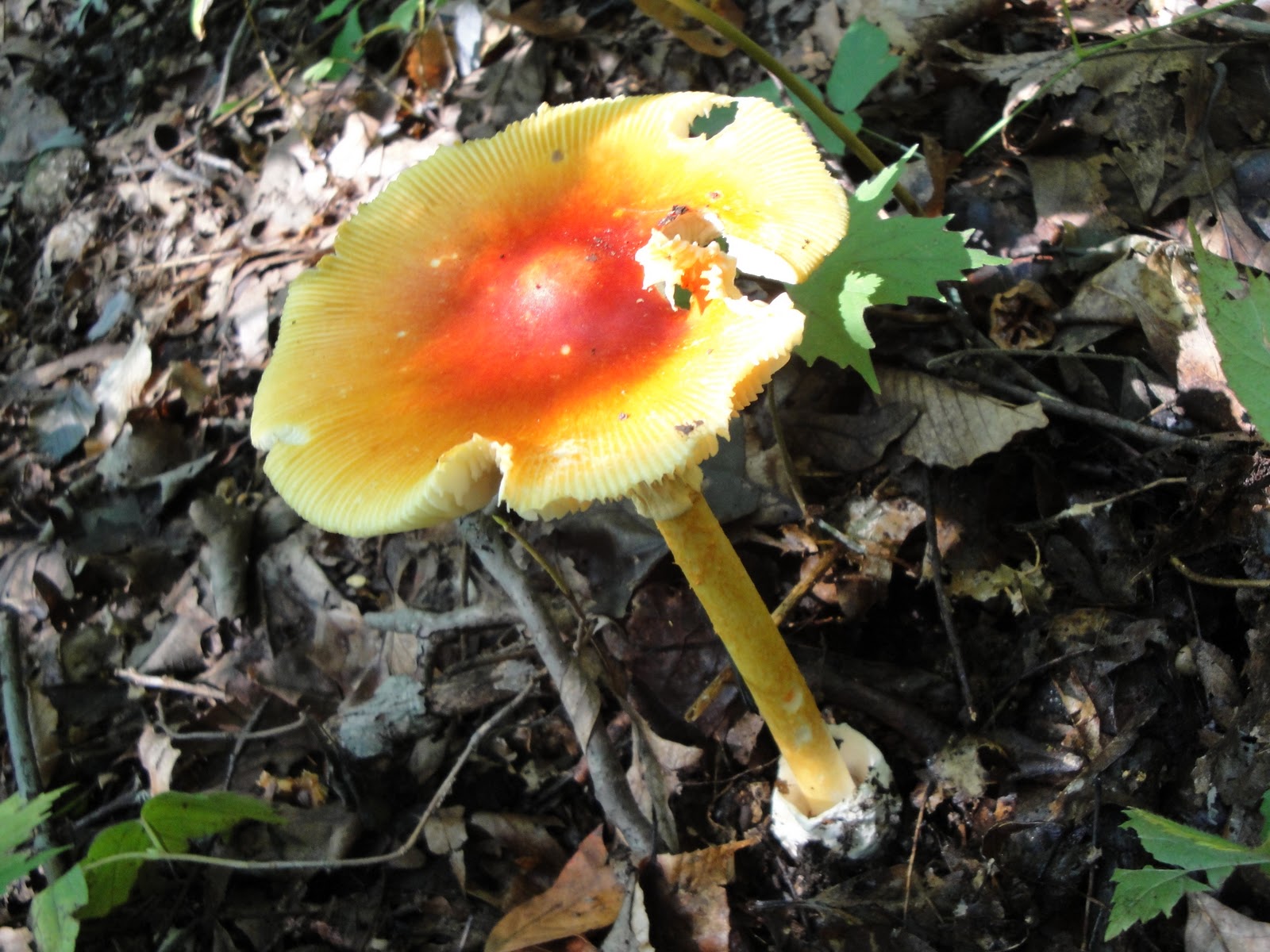

This is the nicest specimen of the alleged A. caesarea I have found. It was a lonely giant of its kind in Rock Creek Park earlier this month.

Before proceeding, I must include another mushroom-eating disclaimer. Don't use my blog as your primary resource. Don't eat mushrooms based on my advice. If you use my blog as inspiration to go learn enough to eat wild mushrooms safely, more power to you.

Now for some good news. I believe the similarities between A. caesarea and A. muscaria var. formosa (I can't speak directly to var. flavivolvata, because I've found no specimens of this) are overblown. Mushroom writers are rightly concerned about an amateur making a mistake based upon their descriptions and getting sick or worse. Some of the differences are in superficial or non-persistent characteristics, which are not usually the best aid to getting an accurate mushroom ID. They are both members of the genus that includes species with such common names as "death cap," "destroying angel" and "fool's mushroom." Amanitas account for 95% of mushroom-related fatalities (thanks Wikipedia). All of this leads to understandable caution. (For more on this general topic, see this entry from a fellow local mushroom blogger.) Fortunately for mycophagists, the deadly ones are much, much easier to distinguish from our hero. This leaves a knowledgeable field mycologist with only the risk of illness - and not much risk of that with enough experience.


Amanita muscaria var. formosa, as found in Watkins Regional Park some time ago. Pictures are not the most reliable way to distinguish mushroom species, but taking a close look at these first two photos is a good start.

How these two species are alike:

Both of these mushrooms exhibit classic Amanita features: the spore print is white, they have both universal and partial veils which persist as volvae (please don't confuse this with vulvae) and rings on mature specimens, their gills are free from the stem.  They are also similar in size, habitat, and season. Both are mycorrhizal with hardwoods and with pines. Both have yellow-to-orange coloring on their caps and white flesh. A key to successful mycology, however, is to learn which things are different and isolate them. Of course, one doesn't want to do so to the exclusion of these basic features, but with experience noting the Amanita characteristics will become second nature, and allow one to focus on some other details.

How these two species are different (the key features):

I think the simplest difference to detect is that A. caesarea has yellow gills while A. muscaria has white gills. This isn't a perfect test, because yellow gills can be so pale as to appear white, and white gills can appear yellow beneath a yellow cap in poor lighting. Another helpful difference can be found around their respective volvae. A. caesarea has a much larger, more persistent volva. A. muscaria tends to have shaggy "skin" near the base of the stem where it meets the volva. Caesar's mushroom has a yellowish stem while fly agaric has a white stem (again, the yellow can fade). Finally, A. muscaria not only has, but is famous for, white warts on top of its cap.  A. caesarea lacks these warts. Any one of the four preceding features is not a sure bet - but all four? Solid. I suppose it is remotely possible to find a specimen of A. muscaria whose warts have fallen off, that has an abnormally large volva and lacks a shaggy stem base, and which appears yellowish in the gills and stem. But doesn't that seem like a long shot to you?


Here's a closeup of the volva of Caesar's mushroom.

This shot was meant to demonstrate the yellow stem and gills - but it also inadvertently
demonstrates how it can be hard to tell if the gills are yellow in the field.
 

Luckily I have this old photo - here you can see A. muscaria var. formosa's  white gills, white stem, and smaller volva. You might be able to pick out the shaggy bits at the stembase as well.


Additional apparent differences:


These are why I think the chance of mistaking one of these mushrooms for the other is slim for careful and experienced mycologists. I will admit the possibility that I'm just not experienced enough. Maybe I'm misidentifying everything, and the range of variability within each species is broader than I think. This is why I've yet to eat any Caesar's mushrooms.

The bulk of these differences are in the caps. Look at the photos of the two species.  Don't they seem quite different? A. caesarea is distinctly orange*, shiny, very striated at the margin, lacking in warts, and possessed of a distinct umbo (that's the bump in the middle). by contrast, A. muscaria var. formosa is pale yellow with slight striations at most, many warts, and no umbo. Using these features for IDing a mushroom is a lot like performing a physical task with bad form - positive results are possible, but you're not putting yourself in the best position for achievement. All of those features are variable within each species and can be changed by the environment, given time. And yet, every time I have collected a specimen of either of these species, it has gone this way: I have noted at first glance that it superficially resembles one species or the other. I have taken notes, brought the specimen home, and obtained a white spore print. Upon examining the four key features above I have corroborated my field guess. This has held true for four or five ocurrences of each species. So what I'm saying is that in theory this group of features is not to be used as a definitive identifier, but experimentally they hold up as a reasonable predictor and starting point.

*since these mushrooms are named for a certain Caesar who purportedly had a taste for them, have I discovered the origins of the name "Orange Julius"?


In addition to the links above (mushroomexpert.com, wikipedia, roger's mushrooms, and the free dictionary) I used the following texts as sources: The National Audubon Society's Field Guide to Mushrooms: North America, Simon and Schuster's Guide to Mushrooms, 100 Edible Mushrooms (Michael Kuo), and Field Guid to Wild Mushrooms of Pennsylvania and the Mid-Atlantic (Bill Russell).

6/12/11

Species Feature #8, Train Wrecker

The train wrecker is a fascinating mushroom, technically an edible but not particularly palatable. I'll get the story of its common name out of the way quickly rather than keep you in suspense. This mushroom has reportedly decayed railroad ties to such a degree that accidents have resulted. These stories, however, may be apocryphal - after all, a number of other organisms were undoubtedly at work on each of the ties in question. Mature specimens can be quite large and showy, and their brown scales, jagged gills and inrolled cap margins can give them a rustic appearance. The stems, too, contribute to this rugged feeling with their often shaggy rings and reddish-brown scales. The size makes this mushroom a tempting kitchen experiment, but it has a tough, leathery texture which prevents it from being truly appetizing.


An immature specimen harvested from a decaying stump. Note the gills' attachment to the stem, and their already ragged nature. The scales on the stem are also readily apparent.

Neolentinus lepideus Quick Facts

Common Name(s): train wrecker, scaly lentinus

Taxonomic Breakdown:

  • Kingdom - Fungi
  • Subkingdom - Dikarya
  • Phylum - Basidiomycota
  • Subphylum - Agaricomycotina
  • Class - Agaricomycetes
  • Order - Gloeophyllales
  • Family -Gloeophyllaceae
  • Genus - Neolentinus
  • Species - lepideus

The genus of this mushroom used to be Lentinus, but as with many fungi these days this has recently changed.

Range:  This mushroom is common throughout North America and Europe. It can be found growing on decaying coniferous wood and occasionally on hardwood as well. It has even been reported in coal mines.


A mature specimen, with a bit of substrate (the thing it grows on and consumes) brought along for good measure.

Here is a closeup of the gills and cap margin in a mature specimen. This one was found deep in Rock Creek Park alongside a picnic table.

It is not recommended to eat this mushroom if collected growing from treated wood - unpleasant substances like the chemicals used for weatherproofing can be taken up in the fruiting body as it grows. I personally don't recommend eating this at all due to its general mediocrity. In Michal Kuo's 100 Edible Mushrooms, Darvin DeShazer quotes another mycophagist, Robert Mackler, thusly: "If it's not at least as good as a portobello, why eat it?" I don't agree fully with this fourth-hand thought (the answer is "because it's cool," or maybe "to find out what it tastes like," etc.). However, having tasted this species I am inclined to agree in this instance. Of course, it isn't recommended to eat ANY wild mushroom at all without extensive knowledge and experience... so keep that in mind as well. If you see a mushroom that looks like the above, the reward side of the risk-reward balance is very small.

5/13/11

May Mushrooms

It's May, and for mushroomers that means you're either riding high from a successful morel season or, like me, disappointed once again by your failure to find morels (not that I've been at this long, or tried more than a couple of times). A lot of mushroom enthusiasts are just now waiting for the showier mushrooms of summer and fall to appear. I caution you, though: if this is your thing, don't write off May! Quite a lot of good edibles grow around this time, and it's when you really start to see some variety out there. From this point until about November in this region, you can more or less count on finding some mushrooms of at least middling interest if it's at all wet outside.

So, what's to be found in May? Well, I'll start you off with some species I encountered on the stroll that inspired this post.


I initially thought that the mushrooms depicted above and to the right were wine caps (Stropharia rugosoannulata) based upon their superficial appearance, the season, and their growing on mulch. When I returned I discovered I was mistaken: wine caps have a distinctive ring which seemed to be lacking, though I do note what appears to be a ring zone near the top of the stem. Wine caps also have white gills which turn purplish black - never the brown color seen here. On top of all that, these don't really look anything like any images I can find of wine caps, after all. The question of course becomes, "well, what are they then?" The answer, to my chagrin, remains "I don't know."


I began and remain quite confident that these (above photo only) mushrooms are scaly inky caps (Coprinopsus variegata). The coprinoid mushrooms are possessed of gills which deliquesce as they mature. Most are edible, although the alcohol inky, so named because it is known to contain a substance which inhibits your body's ability to metabolize alcohol, can make you sick if combined with a couple of beers. I have seen this particular spot produce these mushrooms in spring for three consecutive years.


These two photos show varying stages of the mica cap (Coprinellus micaceus), another coprinoid mushroom that's pretty common around here. This one is easiest to distinguish by the tiny granules on the cap (you might have to expand the picture at the left to see them clearly). However, these have a habit of washing or blowing away quite early in the mushroom's life, so you may need to rely on characteristics. Honestly, I haven't had much trouble getting a fairly positive ID on the little guys most of the time regardless. If you plan to eat them, though, just be sure you DON'T have alcohol inkys instead.


Of course, we couldn't forget our old friend dryad's saddle, could we? These things might get boring fast, and might wind up with the record for most appearances in this blog.


At left are some pictures of a few unidentified mushrooms from the later part of my little stroll. I didn't bother collecting these for later analysis, or taking detailed notes, but I coudn't resist a few quick photos. The first specimen could be a small fawn mushroom, or a large fairy-ring mushroom, or something completely different, like an agrocybe. That's a convoluted way of saying I can't tell from my photograph, because it only offers a limited view of one specimen. I won't bother with my wanton speculation on the identity of the second.

What I've shown you thus far hardly exhausts the list of mushrooms one might find in May. I myself have encountered mower's mushrooms (Panaeolus foenisecii), fairy ring mushrooms (Marasmius oreades), orange dog stinkhorn (Mutinus elegans), and crown-tipped coral (Clavicorona pyxidata), among others. The stinkhorn is one of the foulest living things on the planet. It gets is name because it looks kind of like a dog's penis. It has a slimy, oily secretion which attracts flies and smells and looks like feces. When cut, it smells like I imagine Oscar the Grouch would smell.


I will close with an anecdote related to the above picture. Those tasty morsels are oyster mushrooms which became part of last night's dinner. I was biking home from work, which is what I'm usually doing at 5:30 or so on a Thursday afternoon, when I noticed some mushrooms hanging from a stump right at the edge of the path. Maybe a hundred yards later, my mind said "waaaaaaaaaaiiiiiit a minute! Those looked like oysters - and in good shape!" I brought my bike around and pulled off to the side. Sure enough, oysters they were. I didn't have any wax paper, so I put them in the messenger bag I carried and crossed my fingers against their destruction. Think that meal was satisfying? It most certainly was.

4/28/11

New Old Camera!

This is a little bit of a cheating post. I do have a mushroom to share, but I don't yet know what it is. I'm cheating because my new camera arrived today. It's the same model I'd been using, so I won't be able to snap the kind of insect and other small being photos I dream of, but at least I will have current photos to choose from here. I paused along Beach Drive on the way home from work today - I needed a mushrooming fix, and I have heard tell that morels are out in force (though I may have missed the window).

This afternoon I encountered several RAPs (Random Anonymous Polypores) and several specimens of THAT mushroom. "THAT" mushroom is one that I have been encountering since I began the hobby...it appears early in the season and lasts for several months. It has absolutely generic features, and it completely defies identification. I also found the interesting Boletinoid mushroom I will show below (which eerily resembles THAT mushroom except that it has pores instead of gills).

Enjoy this obligatory new-camera closeup of Franklin. "Lookit that punum" says the stereotypical zany aunt.
The underside of the mushroom I brought home. It has white pores which run down the stem, and it grows from rotting wood.
It has a mottled brown cap, and its patterning is reminiscent of dryad's saddle...though this is certainly not the usual form one would expect of that particular fungus.
It has white flesh which does not stain upon bruising upon exposure. There is also an indentation at the center of the cap, the term for which escapes me. It's called an "umbo" if it's convex instead of concave...
There is no annulus present, and it seems to have no veils either. I now need to wait for a spore print and consult my guides. If I ID this thing, I will update.


This is one of the first photos I took with the new camera. I didn't know what I was doing with all the settings, so it came out in this odd aspect ratio because of my zoom.  In any case, the photo is meant to display the distinctive marbled, flaky bark of the American sycamore. There wasn't a whole lot going on this evening around my apartment, so I had to look to the trees. Fitting, I suppose, since tomorrow is Arbor Day.

Well, like I said, this is a bit of a cheat. G'night folks!

4/27/11

An Overview of Shenandoah National Park

Shenandoah National Park is just a couple of hours from DC, and any time you have the hours it is worth spending them to get there. It's one of the most beautiful places in North America, and it's a personal favorite of mine. It's probably also the single best National  (or State, for that matter) Park I've visited. The biggest strength of the park is the variety it offers. The presence of Skyline Drive means that anyone who can ride in a car can experience nature's majesty there, but bikers and cyclists take advantage, as well. Over 100 miles of the Appalachian Trail wind through the park, and this accounts for a mere twenty percent of the total hiking trail mileage. One can hop out of a car and hike for 100 yards, or one can backpack for over a week. Lodging options range from backcountry camping (with a permit) to living in style at Skyland Resort. Less polarized options include four campgrounds, Big Meadows Lodge, and cabins.

Our favorite spots within the park

Big Meadows (will take a number of photos to really capture)

The Visitor Center photographed from the meadows themselves.

The old man and I resting in a gnarled old tree.
The "back" of the meadow, in a different season. Can you tell that they weren't kidding when they called it "Big"?
We followed some wild turkeys back into the woods which surround Big Meadows; I didn't get any photos though.
Perhaps the best feature of Big Meadows, for us, is that it allows Franklin to really be a Beagle (or a Basset, whichever of his halves you prefer).

Mary's Rock

Laurel enjoys lunch and one of our favorite views within SNP.
Franklin, however, is just tired.

Snead Farm Trail

The old Snead barn...this spot is accessible from a number of hiking circuits. It's a pretty gentle walk up a fire road coming from the Drive. Someone else took a clearer photo here.

Our other favorite spot is the Elkwallow Wayside. I couldn't believe I didn't have my own photos of this...but I'll borrow one. I think we like this place so much because we ran across it after a long, impromptu hike...this was our first trip to the park and we were both very tired and completely unsuspecting that such a place existed. We were in heaven.


Wildlife

The official NPS website provides this nice set of lists. No mushroom list, though, so grrr. I have encounterd black bears, bobcats, eagles and hawks, and a staggering variety of mushrooms. One species I have not seen is the Shenandoah salamander (Plethodon shenandoah). This little guy is interesting because it is found only in Shenandoah National Park, and because it is also the only endangered species within the park. I plan to look for some on my next visit, although it sounds like its range is limited even within the park. The diversity of plants and birds is also incredible, though many of the birds stay so high in the trees that they are rarely seen.

Hello black bear (Ursus americanus). It's fun to greet such an icon of the park (from a distance).
This (wooly) bear was a little smaller. Pyrrharctia isabella larvae are quite well-known, but I'm not sure I'd know the adult on sight.
Yes, there are white-tailed deer as well.
Clavicorona pyxidata is an edible but odd mushroom. It has mild laxative properties, so moderation is in order. I don't recommend eating this (even if you're experienced), because it's not quite tasty enough to make up for the potential negative effects.
I think this is a specimen of Pholiota limonella. I don't know if it has a common name.
I got a three-for one deal here. This white cabbage butterfly, Pieris rapae, decided to feast on some red clover (Trifolium pratense, I believe) amid a field of white clover (Trifolium repens).
A mountain laurel (known superlocally as the "my girlfriend plant"). These are quite common throughout Shenandoah. Binomial name: Kalmia latifolia.
Well, I hope you are intrigued by the wonder of Shenandoah now. I can't wait for my own next trip, and I'm sure I'll have an overexcited blog post to share when I return.

4/19/11

Edible Mushrooms in the Capital Area, Part 2

The flip side of "mushrooming is dangerous" is "the right mushrooms are delicious and healthy." They can occupy a variety of culinary niches, and are low-calorie options. Some have been shown to be quite good for your heart. Even if you're not a vegetarian, eating less meat can be a wise choice, and many mushrooms are wonderful as meat alternatives. Mushrooming is a risk-reward activity, but as with anything else the practiced application of knowledge and patience mitigates the risk. Done properly (which means heeding all those warnings), mushroom hunting gives the reward of an improved diet with the risk of occasional digestive upset.  This sounds better than the risk of dying, right?

There is one more mushroom-related practice I should touch on if I'm interested in the responsible distribution of information. "Shrooming," "doing 'shrooms," or whatever one chooses to call, ahem, 'recreational' mushrooming can also be dangerous. I'm not preaching here, because I'm not talking about the psilocybin itself (harmless in the quantities found in mushrooms, unless you count the hallucinations). This pastime has the same issues as eating wild mushrooms for food - many that will get you high are hard to distinguish from other species that will kill you or make you sick. Amanita muscaria (fly agaric or the fly mushroom - that mushroom with the white spots in all the cartoons) will get one high in Europe but just make one miserable in the States. So, if you're going to get high on mushrooms, learn to ID them yourself. Trusting someone else to find the right ones for you is like trusting a stranger on a street corner to retrieve your correct medicine from a bucket of mixed and unlabeled pills. Also keep in mind that mushrooms which will kill you in tiny doses are legal while those which will only get you high if you eat them like potato chips are illegal. Laws do very by state; some make more sense than others.

And now, on to the photos! Again, all specimens pictured below were collected within a couple of hours driving distance of Washington DC. All are edible for those who have adventurous pallets.

Entoloma abortivum - this is actually two mushrooms, one of which is a parasite on the other.  The honey mushroom (Armillaria mellea) and a species of Entoloma meet. Biologists are still studying which is the host and which is the parasite.  Either way, if you find the brainy-looking part you know you can eat the whole mess - if you dare.

A second photo of E. abortivum, this time featuring the honey mushroom instead of the entoloma. Again, note the distinctive brain-looking globs.

Speaking of the honey mushroom (Armillaria mellea), here it is on its own. That white rot on the wood is pretty distinctive. If you're a sucker for technicalities, you should check out this article.
If you want raw volume in your mushroom meal, not much can match Grifola frondosa (the hen of the woods). That's not a camera trick - my finger is just about touching this monster and the camera is in my other hand. Unfortunately every specimen I've found has been too rotten to bring home.
Polyporus squamosus (dryad's saddle) can also be huge, but by the time it attains this size it isn't quite as tender and delicious. Fantasy artists like to depict sprites and gnomes and such hanging out on these. Oddly enough, when you cut them they have a distinct watermelon smell.
Pleurotus ostreatus (the oyster mushroom) is a mycophagist's dream. It's delicious, gregarious, common, and can be found almost year round. Its lookalikes (assuming you get a spore print, that is) are all related and also edible. This is the second most common commercial mushroom behind the white buttons (Agaricus bisporus, if you care to know).
This hairy-looking oddball is the old man of the woods (Strobilomyces floccopus). Fitting that the species name looks something like the equally funny-looking 'octopus.' Well, I thought so, anyway. Despite appearances, this is actually a very tasty mushroom.
They say everything tastes like chicken. Well, the chicken mushroom, Laetiporus cincinnatus et al, really does. Well, it can be made to. This beautiful mushroom can be prepared in the kitchen in much the same way poultry can, and with less worry of food poisoning.


I have by no means exhausted the range of edible mushrooms in this region of the US. Among those not pictured are fungi with such colorful names as the train wrecker and angel wings. Dozens more have not even crossed my radar yet. I've only been at it a couple of years, but mycology has opened my eyes to the variety of forms life cane take.

4/18/11

Edible Mushrooms in the Capital Area, Part 1

There is a technicality I must get through before posting about eating mushrooms. I have to warn you that unless you know what you are doing - and I mean REALLY know, not "I read about this mushroom in some guy's blog" know - eating wild mushrooms is incredibly dangerous. In this part of the world, there are approximately a half-dozen very common deadly poisonous mushroom species. There are quite a few more which are much less common. Others will not kill a human being, but will make most of us very, very sick. There is at least one species which is perfectly edible but will cause violent nausea and vomiting if alcohol is consumed up to three days before or after eating. Sometimes the substrate (what the mushroom is "eating") can add poisonous qualities to an otherwise safe find; man-made effects can cause similar problems. Even edible mushrooms can provoke allergic reactions in some people, and since most people have not been exposed to a wide variety of wild mushrooms these reactions are largely unpredictable.

It is not the existence of these poisonous species that make mycophagy dangerous. After all, there are deadly poisonous plants, fishes, and so on, and no one tells us not to take up fishing or eat wild blackberries. What makes wild mushrooms so dangerous is that species are not readily identifiable by sight in most cases. A significant amount of work is necessary to determine precisely what mushroom you have, and it is often a very subtle characteristic that separates the deadly from the delicious. Sometimes proper identification requires a spore print. Often a mushroom's environment removes characteristics that have a bearing on identity, such as a ring on the stem (or stipe, if you want to be pompous about it). Sometimes there is more intraspecies than interspecies variation in physical traits.  Further muddying the picture is a simple lack of background science - countless mushroom species are as yet unstudied. Even some of those which have been known and collected for centuries are subjects of taxonomic arguments.

I hope the above has made my point. I fully support new initiates into the hobby of mycology...but if you find yourself intrigued, don't use my blog (or anyone else's) as your point of reference. Understand that it is a hobby to be taken seriously. It can, however, be very safe if the proper cautions are exercised. This means 1) learning to identify all deadly poisonous mushrooms in your area, 2) never eating any mushroom you have not identified with absolute certainty, 3) progressing slowly with small samples for first-time tasters, and 4) never ignoring one trait because another gets your hopes up. With that in mind, I recommend Musroom Expert as an online resource. This book was my first on the topic, and it is written with whimsy alongside real knowledge. Supplementing a fun book like this with a more complete guide, like Audubon's or Simon and Schuster's, is a good place to start.

Now that I have frightened you, and subsequently bored you, I present the photographs. All mushrooms pictured below are specimens found in the Mid-Atlantic United States, and all are edible. In fact, all of these were found within two hours' driving distance from Washington, DC.
Clavicorona pyxidata - one of the first I ate, as it was an easy ID. The closest thing this species has to a common name is "crown-tipped coral." Similar but inedible species grow from the ground and not on wood.

Gyrodon merulioides - This ugly and foul-tasting (but technically edible) mushroom is sometimes known as the ash-tree bolete. It grows like crazy in my apartment complex from late summer through the fall. Its redeeming quality is its fascinating ecological niche. It is only found near ash trees - not because of the trees themselves, but because they are symbiotic with a species of insect which feeds only on ash trees.

In the foreground is a specimen of Cantharellus cinnabarinus (cinnabar-red chanterelle). The background is a mixture of these and Cantharellus lateritius (smooth chanterelle). They were part of a wonderful meal.
Auricularia auricula...known variously as tree ear, jelly ear, and (thanks to racist biologists of bygone days) Jew's ear. Apparently some mycologists treat this like chewing gum (yuck).

Orange jelly, aka Dacrymyces palmatus, is edible...but I haven't been quite so adventurous yet, myself. When a close relative is called "witch's butter," I am somewhat put off.
This is another I've not yet felt bold enough to try, Hericium erinaceus. Colloquially known as the "bearded tooth" this mushroom is odd in oh-so-many ways, not least of which is that one can eat something that looks and feels like this.
Hungry yet? My mouth is watering at the prospect of a new mushroom season. Morels should be appearing right about now in this part of the country. Alas, I've yet to encounter any of these lusted-after but elusive gems in my young mushrooming career. When I do first find this crown jewel of fungi, I'll be sure to share photos and accounts of the dining experience here.