Showing posts with label animal photography. Show all posts

5/8/11

Species Feature #5, Mayapple

The mayapple is nearly ubiquitous spring ground cover in the woods of the Mid-Atlantic. I have noticed it so much this year that it seemed to be just screaming for a feature in this blog. The leaf and the flower are both pretty distinctive, so this is an easy species to identify. The fruit is a green oval that develops from the flower site. They are usually found in large groups, with individual plants liked by rhizomes (connecting root structures). Those rhizomes have been used for chemotherapy and as a topical agent, but eating them (or the fruit) is not recommended. These parts of the plant are poisonous, but only in large quantities.

A sizable cluster of mayapple found in Watkins Regional Park last weekend.

Podophyllum peltatum Quick Facts


Common Name(s): mayapple, hogapple, Indian apple, mayflower, umbrella plant, wild mandrake

Taxonomic Breakdown:

  • Kingdom - Plantae
  • *Division - Magnoliophyta (aka Angiospermae)
  • Class - Magnoliopsida
  • Order - Ranunculales
  • Family - Berberidaceae
  • Genus - Podophyllum
  • Species - peltatum

*For some reason that doesn't make much sense to me, biologists scoff at the term "phylum" for plants. Instead, between Kingdom and Class they split plants into "Divisions." This division is better known as "flowering plants" which are a subset of "seed-bearing plants (Spermatophytes). Why we don't just refer to these levels as phyla and subphyla is beyond me, but hey, I don't make the rules.

Range: Throughout the eastern US as far west as Minnesota and Texas, and North into Canada in places.

Some younger specimens near Rock Creek Park.

Here is an interesting read on the medicinal history and folklore of the mayapple. This site has a wonderful detail photo of the flower, as well as some good information. As the "mandrake" this plant makes an appearance in Shakespeare (see the quote at the top of the first link).

The flower of Podophyllum peltatum.


For variety's sake, a photo from below of mayapple growing by the roadside.

5/5/11

Bike Commuting

The first thing one needs for a bike commute. This happens to be where mine starts.

Commuting via bicycle has been a drastic game-changer in my adult life. There are of course real naturalist's reasons for doing so: cutting your emissions, sticking it to Big Oil, getting out into nature, and so forth. Those were some of my reasons for doing it. But really, my reasons were primarily a lot more selfish. It saves money in the long run, it forced me to get into better shape, and it's just plain fun. The benefits surprised me though - I feel better. I'm less often tired. I'm more alert, and hence better at my job. It makes me crave a better diet (well, most of the time). Finally, if you live here you know how much driving around DC sucks. You know how, no matter one's intentions, most of us pick up horrendous driving habits almost as a set of survival skills and thus contribute to the problem. Where I'm going with this is: I hate my commute so much less. Bike commuting has become a great stress-reducer.

I'm not telling you to (yes I am) start commuting (do it) by bicycle. What I am (are you cycling yet) doing is pointing out that if you live in the DC suburbs it is probably an option for you (get on that bike) even if you think it's not. Take my commute for instance. It begins near Downtown Silver Spring and ends, about ten miles later, in Rockville near Randolph Road. Before my friend Dustin told me about it, I wouldn't have thought there was a straightforward bike route between these two places. Yet, almost all of my ride is on the paved Rock Creek Trail. The Maryland 'burbs are full of these trails: The Millenium Trail, The Matthew Henson Trail, The Capital Crescent Trail and Georgetown Branch Trail (which is more or less complete on both ends, despite mapped appearances), are just a few. Virtually all of the roads in and around Potomac are extremely bike-friendly. If that's not enough, organizations like Bike Arlington and WABA will get you started.

OK, all jokes aside I'm not here to instruct anyone on how to live their lives. If biking isn't for you then it just isn't. But, if you're reading this and have ever considered it, I urge you to consider further, and I hope that I have helped make your decision easier. The rest of what I want to share today is simply a series of photos chronicling one day (today) of biking to work. I hope they will be enticing.

This photo doesn't do it justice, but this is what my coworker and I have come to refer to as THE HILL. In the morning this is a pleasant boost of speed; in the evening it's a last hurdle to clear before showering.

Here the path disappears under Connecticut Avenue. Believe me, this is better than the alternative.

...like this truck full of shit.
As with any form of transportation, however, there are just some days when something completely unexpected holds you up.

Here I'm nearing the end of the bike path (well, for me). Occasionally I take the road you can see here - Beach Drive - instead. It's more dangerous but faster... and traffic here generally knows what's up with the bicycles.

This is the only horrendous intersection (well, aside from the one just outside my apartment) that I must deal with. It's not so bad, though - one just has to wait for the light.

I will finish with some uncaptioned photos from the return trip. Enjoy!


4/30/11

Species Feature #3, Eastern Box Turtle

There's just something cool about an animal with a door for its head, isn't there? I present the Eastern box turtle (Terrapene carolina carolina, also sometimes called the common box turtle). Often in the world of turtles and tortoises it is subtle differences in the markings that make identifying to species possible; however, these turtles have widely varying markings and are best identified by their hinged shell. This alone will take care of the ID for you in the Mid-Atlantic...if it can close its shell all the way you have a common box turtle. Another subspecies is endemic to Florida, one to the Gulf Coast, and yet another just west of the nominate subspecies; the ornate box turtle can be found out West.

I might have propped this fella (I'm fairly sure it's a fella because the underside of the shell - called the plastron - is curved) onto the log for this pose. However, I returned him to his original location...turtles are apparently easily disoriented and moving them is a no-no unless you're helping them out of the road.

 Terrapene carolina carolina Quick Facts

Common Name(s): Eastern box turtle, common box turtle (this second name is to distinguish from other subspecies of T. carolina.)

Taxonomic Breakdown:

  • Kingdom - Animalia
  • Phylum - Chordata
  • Class - Reptilia
  • Order - Testudines
  • Family - Emydidae
  • Genus - Terrapene
  • Species - carolina
  • Subspecies - carolina
Conservation Status: Near Threatened

Range: Massachusetts to Georgia, and West to Illinois and Tenessee

Check out the m-shaped (or e-shaped, depending on your POV) markings on the shell.

I was always particularly fascinated by these creatures as a child. I think I was captivated by the mystery of what's inside the shell more than anything. It's also nifty that despite their vast differences from mammals, in their dietary habits they are much like us - that is to say, opportunistic and omnivorous.
I think looking closely at the indentation confirms sex, but I don't want to be too confident because sexing turtles and tortoises is notoriously difficult.
This individual was a little less shy at first, allowing us a glimpse of its beak and clawed feet.
However, a confused and agitated Franklin took care of that in short order.

Before I let you go, I want to make note that I will be continually updating my post "Naturalism on Speed" with each new species I am able to identify while biking. If such things interest you at all, you can check in any time. I'm including a date with each newly added species so you can tell at a glance if anything is new to you.

4/28/11

New Old Camera!

This is a little bit of a cheating post. I do have a mushroom to share, but I don't yet know what it is. I'm cheating because my new camera arrived today. It's the same model I'd been using, so I won't be able to snap the kind of insect and other small being photos I dream of, but at least I will have current photos to choose from here. I paused along Beach Drive on the way home from work today - I needed a mushrooming fix, and I have heard tell that morels are out in force (though I may have missed the window).

This afternoon I encountered several RAPs (Random Anonymous Polypores) and several specimens of THAT mushroom. "THAT" mushroom is one that I have been encountering since I began the hobby...it appears early in the season and lasts for several months. It has absolutely generic features, and it completely defies identification. I also found the interesting Boletinoid mushroom I will show below (which eerily resembles THAT mushroom except that it has pores instead of gills).

Enjoy this obligatory new-camera closeup of Franklin. "Lookit that punum" says the stereotypical zany aunt.
The underside of the mushroom I brought home. It has white pores which run down the stem, and it grows from rotting wood.
It has a mottled brown cap, and its patterning is reminiscent of dryad's saddle...though this is certainly not the usual form one would expect of that particular fungus.
It has white flesh which does not stain upon bruising upon exposure. There is also an indentation at the center of the cap, the term for which escapes me. It's called an "umbo" if it's convex instead of concave...
There is no annulus present, and it seems to have no veils either. I now need to wait for a spore print and consult my guides. If I ID this thing, I will update.


This is one of the first photos I took with the new camera. I didn't know what I was doing with all the settings, so it came out in this odd aspect ratio because of my zoom.  In any case, the photo is meant to display the distinctive marbled, flaky bark of the American sycamore. There wasn't a whole lot going on this evening around my apartment, so I had to look to the trees. Fitting, I suppose, since tomorrow is Arbor Day.

Well, like I said, this is a bit of a cheat. G'night folks!

4/26/11

Species Feature #2, White-Tailed Deer

I know I'm not thrilling anyone in the mid-Atlantic with exotic species just yet. The white-tailed deer (Odocoileus virginianus) is as ubiquitous here as the human being, and it is that trait which essentially requires me to treat this species early. I have grown numb tot he creatures over the years, but they can be majestic and there is a wealth of information readily available.

Photo credit to Laurel; taken at Big Meadows in Shenandoah National Park. Momma was not real happy with two humans and a dog so close.

Odocoileus virginianus Quick Facts

Common Name(s): white-tailed deer, Virginia deer, whitetail

Taxonomic Breakdown:

  • Kingdom - Animalia
  • Phylum - Chordata
  • Class - Mammalia
  • Order - Artiodactyla
  • Family - Cervidae (Subfamily - Cepriolinae)
  • Genus -Odocoileus
  • Species -virginianus
Conservation Status: Least Concern

Name of Young: fawn
Sex-Specific Names: buck, stag (M); doe (F)

Range: Widespread across most of North America; south as far as northern Chile

More deer grazing in Big Meadows.
I have heard the white-tailed deer referred to as "the most dangerous animal in North America" because of all the auto accidents. However, some (limited) web research seems to debunk this. Here's a North American list...it seems the whitetail gets consideration mostly from a lack of contenders. It appears that the death toll is on the order of 100 per year, including the vehicular mishaps - the same as that of the American bison. Given the disparity in populations (in the wild, approximately 30 million deer vs. approximately 30,000 bison - a factor of one thousand), I'd have to give the bison a clear advantage here.

Speaking of population, it's a problem. Deer are vastly overpopulated. We create their habitat and kill their predators, and this species is remarkably adaptable to begin with. Some places have even gone so far as to practice netting and bolting. I'm not sure I'm strongly against this; it might not be the most humane thing but neither is letting them continue to damage the environment with their overpopulation. It is certainly a complex issue, made more complex by their simple cuteness. I suppose the way I do feel is: eat venison. It's a sustainable meat and leaner than beef. Sometimes it's hard to come by, though.

Some older fawns hanging out around the Rachel Carson Greenway Trail. This time mom peed at me in frustration.
I was surprised at my lack of good deer photos, and almost as surprised that the best all seemed to contain at least one fawn.


I will leave you with this: the state of West Virginia, during my childhood there, enacted a roadkill law which was the subject of much ridicule. However, it was intended as a partial solution to the deer problem and a poverty problem. For those whose vehicles were damaged by these beasts, it offered an opportunity to recoup some of those losses in terms of several good meals. A small family can eat for some time from one deer. Although, in practice I think the results were pretty close to the jokes. I recall my parents getting a call from the warden asking if they'd like to claim a deer that had died on our property after being hit. The call came about three days after it was struck, and was met with a reply of "no thanks; we'd prefer you remove this rotting thing from our yard."

4/24/11

Species Feature #1, Eastern Cottontail (Happy Easter)!

I won't beat anyone over the head with Jesus (apparently we don't do that in the suburbs), but you will take this bunny and like it! This eastern cottontail (Sylvilagus floridanus) seems content in on his mat of white clover (Trifolium repens) , but also seems to have forgotten his basket of eggs.
Before I get started, I want to wish everyone a happy belated Earth Day! For some reason I was thoroughly convinced that Easter and Earth Day were the same day this year, and I missed it. I don't feel so bad, though, because Laurel has done some work for the Earth Day Network in the past, and she was under the same false impression.

Sylvilagus floridanus Quick Facts

Common Name: Eastern cottontail

Taxonomic Breakdown (Five Kingdom Model)
  • Kingdom - Animalia
  • Phylum - Chordata
  • Class - Mammalia
  • Order - Lagomorpha
  • Family - Leporidae
  • Genus - Sylvilagus
  • Species - floridanus
Conservation Status: Least Concern
Name of Young: Kits

Range: Northern South America to Canada, Primarily East of the Mississippi in the US

There's not a whole lot else to say about this species. If you live in this area, you are certainly familiar with it at least in passing. It eats mostly grasses, but will invade fruit and vegetable gardens for tastier treats, and subsists on twigs and bark during the winter months. The phrase "breeding like rabbits" is not without cause, but there are plenty of predators (and enough traffic) to keep the population under control. One fact that was new to me as I researched for this post was that juveniles have a distinctive and adorable white blaze on their foreheads. There are somewhere in the neighborhood of twenty subspecies, with only about five found in the US. If you want more, your safest bet is probably a Google search of the binomial name.

4/23/11

The Naturalist's Toolbox

Stephen King, whose work I admire, likes to talk about his "toolbox" when discussing the craft of writing. Other writers (and others in almost any field of work or serious hobby) use this concept, of course, but King is the one who really introduced me to it in its more abstract sense. I'll cover the naturalist's toolbox in both ephemeral and concrete terms below.

What do you need to be a good naturalist? Well, if you ask me it's the ephemeral stuff that's important. Stripped to its most basic essentials, the naturalist's toolbox contains:
  • Eyes
  • Keen observational skills
  • Patience
  • Interest in nature
  • Clothing (you will, after all, be outside)
To the last bullet on the list, I will add that there is probably such a thing as "nude naturalism," but I'm talking about how to be a naturalist and retain a sane outward appearance. Really, though, anyone can be a naturalist with just those five things. The gear and gadgetry I will lay out below will certainly make outdoor experiences more enjoyable and rewarding, but since none of these things are hard and fast requirements nature hobbies can be as frugal or as expensive as your budget allows.

There is of course a lot of variation in useful items depending upon your particular area(s) of interest. Following which things are best for which interests isn't rocket science, though, so I'll try not to lead you by the nose.


Hiking Essentials

Just about every outdoor adventure will involve some amount of walking, so I'll start there. The equipment list for this is pretty basic. For any significant hike, you will need:
  • Hiking boots - preferably waterproofed or at least water resistant
  • Comfortable socks
  • Layers of clothing (obviously, your hiking wardrobe will vary seasonally)
  • A poncho
  • A map and compass for any hike where becoming lost is even a remote possibility
  • water - I recommend those steel, screw-top bottles (preferably with carabiners)
  • Trail food
  • First-aid kit
  • A backpack or similar carryall device

Useful, but not absolute must-have, items include:

  • Bug spray
  • sunscreen (this IS a must have in some environments)
  • A pocket knife or leatherman tool
  • A flashlight (necessary, of course, if your hike will be at night)
  • Extra carabiners (you will be surprised how many ways these can help you out)

Everything else you might want is really up to the hiker's discretion. Some folks love to have cell phones or GPS equipment; others prefer a much more off-the-grid approach.


Observational Aides

There are really only two items (three if you're a stargazer) that fall into this category, but they are important enough that I thought they deserved their own bolded and underlined subheading. I'm going to skip that third option, but I do have a few brief words to share on binoculars and cameras.

Binoculars are great to have when you want them. If you're a birder, they are all but necessary. However, in my experience they have often been a clunky and heavy extra burden. The secret with this tool is to know when to bring it along, and when to write off the more distant sightings as something for another trip. Binocs are available at widely ranging prices, but I wouldn't recommend the super-cheap or the super-expensive. If you don't want to spend at least $50, then the naked eye approach is probably adequate.

Cameras are also available across a broad spectrum of cost and quality. In this case, the super-cheap just might be OK, depending on what you want to photograph. If mushrooms or plants are your passion, then you can get away with a fairly low-quality model that won't break the bank. I'll illustrate below:

This was taken with the low-quality camera I've been stuck with for the last few weeks. It might not be exemplary, but it gets the point across.
However, if insects, spiders, or other tiny creatures are your cup of tea, a more advanced model with a robust zoom lens is going to be necessary. Consider the botched attempt below, taken with a reasonably good digital camera:

Yuck, right? This was the best of about a half-dozen attempts made before a resigned sigh.
This was a slightly more successful effort with the same equipment. Still, if I were to take up entomology instead of mycology as a primary focus, I'd clearly need something better.
The other problem is that animals, well, they move. If your subject of choice is quick and wily, you'll need a camera with great shutter speed. If fishes or other underwater life thrill you, then you'll need an underwater camera and a host of other materials which fall outside my range of experience. The takeaway from all this is to remember what your goal is when you're camera shopping - this way you can avoid overkill on the one hand and inflated expectations a point-and-shoot model on the other.


Literature

There are a wealth of resources available for the aspiring naturalist. The internet is a pretty good place to start, although if you're reading my blog I suppose you've figured that much out already. Believe it or not, Wikipedia is a pretty good resource if you have an idea of the common name of what you're looking for. Quite a number of universities keep detailed sites - often with information not yet published elsewhere. National and State Parks, wildlife and nature preserves, and other similar places often feature useful lists of native species on their websites. Googling something like "funny-looking green beetle" can actually yield surprisingly helpful results on occasion, as well. However, the internet is not quite perfect for the confused and frustrated outdoorsman.

Sometimes you might want to identify something for which you have no search terms to even try - you just need to start with pictures. In that case, you need guidebooks. The below snapshots will give you an idea what I'm talking about.

You'll notice I have four mushroom guides, but only one for any other single topic. This is simply because of the added complexity of mushroom identification. Sometimes it is important to verify your result with a second guide that emphasizes slightly different features.
 As you can see, I'm partial to Audubon guides. Their color plates are simply unmatched. Sibley is another well-respected and quite good publisher. My bird guide (see below) is from Stokes. I am personally not a fan of Petersenor Simon and Schuster guides, but these options work for some. As a child, I couldn't get enough of the Golden Guides, and I highly recommend these for anyone ages 8-10 through high school age.

The Weather Field Guide hasn't been as useful as I'd hoped, but it is interesting. At the far right you can see I've kept my Boy Scout Handbook, just in case. I still suck at tying knots without a reference, so I confess to using it once or twice in adulthood.
The other type of guide worth noting is the hike guide. You can find these for just about any region, and for this area I highly recommend the 60 Hikes Within 60 Miles guidebook. This series has entries for places as widespread as San Francisco, Atlanta, Cincinnati, Phoenix, and Portland. Avid hikers living close to DC should consider owning just about any hike guide with Shenandoah National Park in the title, as well.

Finally, I should discuss magazines. From publications like Science and Nature to more specifics (I get a quarterly pub simply called Mushroom) these can be an excellent way to learn things that are simply too detailed to be covered in the guides. You are also getting a more varied perspective, since the guidebooks tend to have a single author, or at most a small team of authors. I'm somewhat surprised at the volume of periodicals that remain out there in the internet age, but if you have thought of it there is probably a magazine devoted to it.

I'm sure I haven't blown too many people away with information here, but I hope there's a takeaway or two here. What I'm really driving at is that nature-lovers can start a full-fledged hobby with very little outlay of money - and yet, for those who want to be well equipped the resources to aid you are virtually limitless.

4/22/11

Another Trip to Rock Creek Park

Rock Creek Park will probably become a running theme in this blog; I live down the street, and will soon be moving even closer. It's home to most of the region's wildlife species, so even though it isn't the cleanest of parks it is well worth a naturalist's time to visit.  Since I've already shared a bit of information about the park, I'll get right to the pictures. This walk took place in June of 2010.

The first sighting on this walk was this mushroom, which I believe to be a youngish specimen of Neolentinus lepideus (train-wrecker). It was growing on the root system of a stump, but dry air seems to have gotten to it before it could mature into the showy specimens one sometimes encounters.

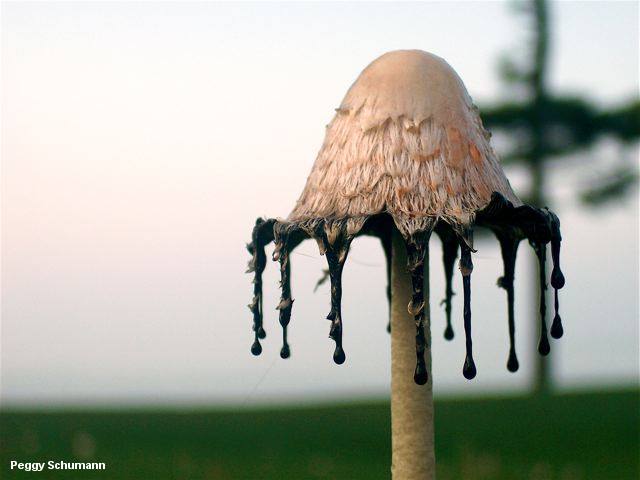
Copinus variegatus (scaly inky-cap) was also hanging out on the property. The inky-caps get their name because their gills liquesce into a black goo over time. If you find them (and succeed in positively IDing them, of course) before this happens, they are edible.

"Sensitive Amphibians," eh? I picture a couple of frogs in marriage counseling. "Fred, you really don't make me feel loved." "But Margaret, who needs love for breeding?"
This mushroom is one that I've encountered dozens of times over the last two years. Its identity continues to confound me. It might not even always be the same mushroom. The features are so generic but so consistently the same to be maddening. I haven't managed to get a single spore print from this sneaky bugger, but it is large an omnipresent around here. If any mycologists who know stumble upon this and laugh at me, please let me know!

Fuligo septica (dog vomit slime mold, or scrambled egg slime). Everything about this is gross, but it's interesting. Slime molds are actually protozoa that present similarly to fungi. The names all convey its nastiness, don't they? 'Dog vomit,' 'egg slime,' 'septic'.. I don't think it's edible, and if it is I don't want to know.


I'm not at all sure what this is, apart from a gorgeous insect. Apologies for the blurry photo, but it was the best I could come up with after tailing this guy for 15 minutes or so. It was pretty sizable - perhaps 2-3 inches long. I've still got some holes in my guide collection, so I made only a cursory attempt to identify this beauty after I got home. I'm hoping over time to have many fewer "cool thing that I can't name for you" entries here.


Identifying this Calopteryx maculata (ebony jewelwing) taught me the actual difference between a damselfly and a dragonfly. About.com is actually useful for once, so just read that!

I don't know what species of beetle this is infesting my oyster mushrooms, but they seem to pop up quite often. I can only find reference to them so far as "a small black beetle" that likes this mushroom. Go figure. (Actually, don't. Instead, keep reading my blog!)
The oyster mushroom above had another - and more startling - neighbor. This Nerodia sipedon (northern water snake) caught me unawares while I was harvesting. It didn't seem to mind the company much, as it only gave me a wary eye and didn't threaten or try to escape.
I love woodpeckers (no penis jokes, please). This fine specimen of Dryocopus pileatus (pileated woodpecker) was seen with a second - ostensibly its mate - just at the exit to the park. This sighting was probably the highlight of the walk for yours truly.
The residential area I made my return trip through was positively awash in Asclepius syriaca (common milkweed). It's pretty, but it is high in allergens. This stuff, among other things, really nails me every summer here.

This is what I meant by pretty - very showy flowers and greenery.
I have to say that while this hike might not have presented me with the strange and unusual, it certainly offered a variety of observable life. For a guy like me (read: "nerd," "naturalist," or "outdoorsman," whichever spin you prefer) any day that includes photo ops of life spanning four kingdoms is a mark in the win column.

4/18/11

Edible Mushrooms in the Capital Area, Part 1

There is a technicality I must get through before posting about eating mushrooms. I have to warn you that unless you know what you are doing - and I mean REALLY know, not "I read about this mushroom in some guy's blog" know - eating wild mushrooms is incredibly dangerous. In this part of the world, there are approximately a half-dozen very common deadly poisonous mushroom species. There are quite a few more which are much less common. Others will not kill a human being, but will make most of us very, very sick. There is at least one species which is perfectly edible but will cause violent nausea and vomiting if alcohol is consumed up to three days before or after eating. Sometimes the substrate (what the mushroom is "eating") can add poisonous qualities to an otherwise safe find; man-made effects can cause similar problems. Even edible mushrooms can provoke allergic reactions in some people, and since most people have not been exposed to a wide variety of wild mushrooms these reactions are largely unpredictable.

It is not the existence of these poisonous species that make mycophagy dangerous. After all, there are deadly poisonous plants, fishes, and so on, and no one tells us not to take up fishing or eat wild blackberries. What makes wild mushrooms so dangerous is that species are not readily identifiable by sight in most cases. A significant amount of work is necessary to determine precisely what mushroom you have, and it is often a very subtle characteristic that separates the deadly from the delicious. Sometimes proper identification requires a spore print. Often a mushroom's environment removes characteristics that have a bearing on identity, such as a ring on the stem (or stipe, if you want to be pompous about it). Sometimes there is more intraspecies than interspecies variation in physical traits.  Further muddying the picture is a simple lack of background science - countless mushroom species are as yet unstudied. Even some of those which have been known and collected for centuries are subjects of taxonomic arguments.

I hope the above has made my point. I fully support new initiates into the hobby of mycology...but if you find yourself intrigued, don't use my blog (or anyone else's) as your point of reference. Understand that it is a hobby to be taken seriously. It can, however, be very safe if the proper cautions are exercised. This means 1) learning to identify all deadly poisonous mushrooms in your area, 2) never eating any mushroom you have not identified with absolute certainty, 3) progressing slowly with small samples for first-time tasters, and 4) never ignoring one trait because another gets your hopes up. With that in mind, I recommend Musroom Expert as an online resource. This book was my first on the topic, and it is written with whimsy alongside real knowledge. Supplementing a fun book like this with a more complete guide, like Audubon's or Simon and Schuster's, is a good place to start.

Now that I have frightened you, and subsequently bored you, I present the photographs. All mushrooms pictured below are specimens found in the Mid-Atlantic United States, and all are edible. In fact, all of these were found within two hours' driving distance from Washington, DC.
Clavicorona pyxidata - one of the first I ate, as it was an easy ID. The closest thing this species has to a common name is "crown-tipped coral." Similar but inedible species grow from the ground and not on wood.

Gyrodon merulioides - This ugly and foul-tasting (but technically edible) mushroom is sometimes known as the ash-tree bolete. It grows like crazy in my apartment complex from late summer through the fall. Its redeeming quality is its fascinating ecological niche. It is only found near ash trees - not because of the trees themselves, but because they are symbiotic with a species of insect which feeds only on ash trees.

In the foreground is a specimen of Cantharellus cinnabarinus (cinnabar-red chanterelle). The background is a mixture of these and Cantharellus lateritius (smooth chanterelle). They were part of a wonderful meal.
Auricularia auricula...known variously as tree ear, jelly ear, and (thanks to racist biologists of bygone days) Jew's ear. Apparently some mycologists treat this like chewing gum (yuck).

Orange jelly, aka Dacrymyces palmatus, is edible...but I haven't been quite so adventurous yet, myself. When a close relative is called "witch's butter," I am somewhat put off.
This is another I've not yet felt bold enough to try, Hericium erinaceus. Colloquially known as the "bearded tooth" this mushroom is odd in oh-so-many ways, not least of which is that one can eat something that looks and feels like this.
Hungry yet? My mouth is watering at the prospect of a new mushroom season. Morels should be appearing right about now in this part of the country. Alas, I've yet to encounter any of these lusted-after but elusive gems in my young mushrooming career. When I do first find this crown jewel of fungi, I'll be sure to share photos and accounts of the dining experience here.