Showing posts with label Shenandoah National Park. Show all posts

3/3/12

Species Feature #11, Mountain Laurel

I thought now would be a fitting time to feature this species, given my recent engagement to Laurel. While I believe she was technically named for the bay laurel (which isn't even closely related, taxonomically speaking), the mountain laurel is about as close as we're likely to find growing wild in this area. In this case "close" refers non-scientifically to plants called "laurels."

Mountain laurels have stunningly beautiful white flowers with red or pink highlights. Something I didn't realize about them is that they are evergreens... and so my prior thoughts about them as a "sign of spring" were in error. Still, I don't think they're generally quite as striking in winter as they have appeared the last few weeks.


A very photogenic plant.
 
Kalmia latifolia Quick Facts

Common Name(s): Mountain Laurel, Spoonwood, Ivybush, Sheep laurel, Lambkill, Calico bush

Taxonomic Breakdown:

  • Kingdom - Plantae
  • Division (Phylum level) - Magnoliophyta (aka Angiospermae)
  • Class - Eudicots (not technically a Class, but this is an approximation)
  • Order - Asterids (another approximation. Asterids are part of the "core Eudicots.")
  • Family -Eracaceae
  • Genus - Kalmia
  • Species - latifolia

Range:  From southern Maine to northwest Florida. It can be found as far west as Mississippi with patches in Indiana and Louisiana as well.

Showing off its evergreen properties in the snow

The ovine names above were bestowed upon the plant because of its poisonous properties. It has been known to kill sheep, cattle, and horses and is also toxic to humans. I was alarmed to read that the plant is toxic, yet used in food... and that it isn't one of those situations in which the toxicity is removed with cooking. I dare not investigate this further, lest I become paralyzed with fear.

Mountain laurels are gregarious in this area, and quite hardy. I have of course found them in Shenandoah National Park, but I have also noted their presence in myriad other places. Patuxent wildlife refuge has its share, as does Seneca Creek State Park. The flowers of course are the easiest way to identify this species, but the leaves are also fairly distinctive, at least when compared to other shrubs of the Mid-Atlantic.

The family to which it belongs, commonly referred to as the "heath' or "heather" family, is also home to a variety of familiar plants. Several berries (blueberries and cranberries, notably) are members of this family. Azaleas and rhododendrons also fit here, as do the common heathers of Europe.

Showing off its hardiness by growing from a rock.
I want to conclude with a note about the "taxonomic breakdown" I have been including in these features. It is important to note that these things are fluid, and one biologist may not agree with another over a species' placement. Further muddling this is the fact that there are even competing systems of classification, and that when it comes to plants phyla, classes, and orders are really "clades" which are not quite at the same level of biological classification. I have listed them that way to avoid confusion, and hope that I haven't instead created confusion. Believe it or not, Wikipedia is a reasonably reliable source for sorting this all out. I don't trust it to have the most current information, but it does do a good job of discussing the competing systems and, for example, what an "Angiosperm" is.

2/29/12

12 Months of Nature: February

Like February (that most dismal of months) itself, the February section of  Seasonal Guide to the Natural Year was generally short and forbidding. When conceiving this project, I had expected some months to be easier than others, and even expected to fail spectacularly at achieving the aim of my journey once or twice. But after reading my options for February, I despaired of even being able to put together a trip worthy of this blog... would "12 months of nature" become "11 out of 12 months of nature" so soon?

Option 1, "Winter Hawks" sounded promising until I discovered that all of the recommended spots were prohibitively far away. Option 2, "Tracking" seemed a little too general and unexciting for my purposes. Options 3 and 4 were titled "Lake Eerie Steelhead,"  and "Exploring Winter Beaches," respectively - both of which were also out because of travel time. The final option, "Pelagic Birding Trips," sounded fascinating but requires much more organization than I had the time or inclination to put together. Frankly, I had to look up the word 'pelagic' anyway.


February Event: Tracking

My choice of a human footprint here doesn't mean
I failed entirely...
So, I chose "Tracking" from the list above. I could have instead resigned myself to traveling a greater distance than I wanted to with a good chance of not seeing the hawks or steelhead I sought. The payoff might have been far more interesting. But the conservative approach meant that it would be hard to fail. One of my favorite places, Shenandoah National Park, was a recommended destination. There was the possibility of snow, which would only make track identification easier, in theory. Besides, the point of tracking isn't necessarily to find fauna itself, but to understand and interpret signs of its presence and impact on the environment.


The Location

I have repeatedly talked about this place, and I'm sure it will come up over and over again in this blog. So I won't bore you with redundancies (except in link form). Looking back, though, it's hard to believe I only have one post solely about Shenandoah.

Why there, and Why then?

Well, the guide was right about one thing. There was definitely snow.
The answer to "why there" was sort of unclear... really, one can track anywhere outside. Animals walk, poop, eat, and so forth everywhere. I think the guide suggested Shenandoah primarily because there is a ton of open space, and because wildlife traffic is a lot higher than most places in this region of the US. I had an ulterior motive for going to the park that most of my readers are aware of. So "why then," then? Well, I think they stuck "tracking" in February primarily because it was the toughest month to fill out with reasonable activities, but also because of the likelihood of snow.


The Trip, and What I Learned

Like the previous trip, this one was wonderful. Unfortunately I didn't learn much about tracking - I relied on a few things I already know and just enjoyed getting a good hike in in February. We got to the park pretty early, and chose one of our favorite spots: Mary's Rock. (There are those ulterior motives again). The last time we had done this hike was in the hottest part of the summer, so it was a nice change of pace (and still gorgeous) to hike it with a dusting of snow. What's nice about this hike is that although steep, it's less than a two-mile trip from the parking lot to the summit. And the view is spectacular.

The trailhead - per the sign, much of this hike is on the Appalachian Trail.

We thought this was beautiful - a veritable explosion of color amid the white, gray, and brown.

I have a couple of decent photos of the view from Mary's Rock itself, but I don't feel they do it justice. If you follow the link above there are a couple that almost get the job done, but it's one of those things you just have to see to appreciate fully. Luckily for DC denizens, it's not too far away and you don't have to be a marathon runner to pull off the climb.

When we were finished with that hike, we decided to make a quick stop at one of the park's other notable spots, Big Meadows. As usual, there were quite a few deer nearby (and signs of other fauna, which I'll get to). I have to say, though, that Big Meadows is pretty drab in the dead of winter. There's still a certain beauty to the place, and I'm glad I have seen it in its more dormant state, but I wouldn't put it at the top of my list for winter outings.
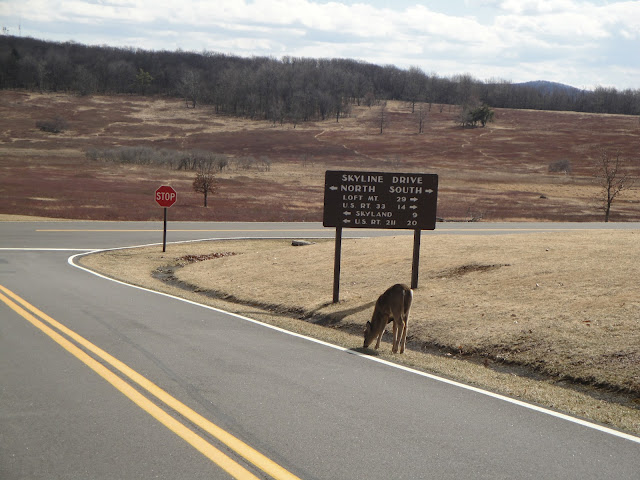
Big Meadows and one of the creatures it is famed for. As a nerd about such things, it has often bothered me that "Big Meadows" is a singular proper noun for a place composed of plural meadows. But I digress (as usual).


My guess is these were left by a squirrel. But it's hard to be
certain without a clear footprint.
 You don't even have to be an astute reader to wonder where the bit about tracking is, since that was after all the point of the exercise. Well, to be frank, we didn't find a lot of identifiable tracks, even in the snow. I think the amount of snow was such that it made it harder rather than easier - just enough to cover any visible tracks but not enough to leave good tracks. Also, the ground was still frozen. Any place where deer or some other large animal had clearly been was mostly torn up into a tangled mess. The clearest tracks were those left by fellow hikers and their canines. However, as you'll see below, footprints aren't the only signs one can use as clues to animal activity.


Deer poop
 I apologize for this next photo, but one just can't talk with any reasonable credibility about tracking without briefly discussing poop. It just can't be done. The scat at right belongs to white-tailed deer, although on this trip we also saw quite a bit of carnivores' waste as well. It could have been from foxes, coyotes, bobcats, or possibly just family pets. There was a lot of high fur content, though (you can tell just by glancing) so my guess is "coyote." In the past there was an unfortunate incident involving Franklin and some bear feces, but I don't want to talk about it. So end my scatological ramblings for the day.


A couple of other signs of note were some loose feathers, and some obvious groundhog trails. Photos of those are even more boring than photos of poop, though, so I'll let it go.

When tracking, what a good naturalist is really after is not just  an identity of what had passed this way, but a story of what it was doing and why. If the deer tracks are clustered in one muddy spot, what made them behave this way? Was it a predator? A mating display or fight for dominance? If there's loose fur, did the owner just get snagged on a twig or was there some sort of conflict? How recent are the tracks you're looking at? Was the animal moving quickly or slowly? One thing I noticed was that some of the deer scat was clustered into piles, while other spots were scattered. This led me to wonder why those particular deer were exhibiting divergent restroom behaviors. It's this type of question that can turn one from aware of nature's signs to an expert at interpreting them. Myself, I'm somewhere in between... I know how to ask the questions but not often how to answer them. Good guides on tracking do exist, though I can't offer much in the way of critique. If you're interested in learning how to track and "read sign" I suggest that you research these and select one... but it's really the experience that will teach you. I will leave you with my favorite deer picture from the day.

This young buck is showing his antler velvet... I've never managed a clear photo of this before, so I'll call it a win.

4/27/11

An Overview of Shenandoah National Park

Shenandoah National Park is just a couple of hours from DC, and any time you have the hours it is worth spending them to get there. It's one of the most beautiful places in North America, and it's a personal favorite of mine. It's probably also the single best National  (or State, for that matter) Park I've visited. The biggest strength of the park is the variety it offers. The presence of Skyline Drive means that anyone who can ride in a car can experience nature's majesty there, but bikers and cyclists take advantage, as well. Over 100 miles of the Appalachian Trail wind through the park, and this accounts for a mere twenty percent of the total hiking trail mileage. One can hop out of a car and hike for 100 yards, or one can backpack for over a week. Lodging options range from backcountry camping (with a permit) to living in style at Skyland Resort. Less polarized options include four campgrounds, Big Meadows Lodge, and cabins.

Our favorite spots within the park

Big Meadows (will take a number of photos to really capture)

The Visitor Center photographed from the meadows themselves.

The old man and I resting in a gnarled old tree.
The "back" of the meadow, in a different season. Can you tell that they weren't kidding when they called it "Big"?
We followed some wild turkeys back into the woods which surround Big Meadows; I didn't get any photos though.
Perhaps the best feature of Big Meadows, for us, is that it allows Franklin to really be a Beagle (or a Basset, whichever of his halves you prefer).

Mary's Rock

Laurel enjoys lunch and one of our favorite views within SNP.
Franklin, however, is just tired.

Snead Farm Trail

The old Snead barn...this spot is accessible from a number of hiking circuits. It's a pretty gentle walk up a fire road coming from the Drive. Someone else took a clearer photo here.

Our other favorite spot is the Elkwallow Wayside. I couldn't believe I didn't have my own photos of this...but I'll borrow one. I think we like this place so much because we ran across it after a long, impromptu hike...this was our first trip to the park and we were both very tired and completely unsuspecting that such a place existed. We were in heaven.


Wildlife

The official NPS website provides this nice set of lists. No mushroom list, though, so grrr. I have encounterd black bears, bobcats, eagles and hawks, and a staggering variety of mushrooms. One species I have not seen is the Shenandoah salamander (Plethodon shenandoah). This little guy is interesting because it is found only in Shenandoah National Park, and because it is also the only endangered species within the park. I plan to look for some on my next visit, although it sounds like its range is limited even within the park. The diversity of plants and birds is also incredible, though many of the birds stay so high in the trees that they are rarely seen.

Hello black bear (Ursus americanus). It's fun to greet such an icon of the park (from a distance).
This (wooly) bear was a little smaller. Pyrrharctia isabella larvae are quite well-known, but I'm not sure I'd know the adult on sight.
Yes, there are white-tailed deer as well.
Clavicorona pyxidata is an edible but odd mushroom. It has mild laxative properties, so moderation is in order. I don't recommend eating this (even if you're experienced), because it's not quite tasty enough to make up for the potential negative effects.
I think this is a specimen of Pholiota limonella. I don't know if it has a common name.
I got a three-for one deal here. This white cabbage butterfly, Pieris rapae, decided to feast on some red clover (Trifolium pratense, I believe) amid a field of white clover (Trifolium repens).
A mountain laurel (known superlocally as the "my girlfriend plant"). These are quite common throughout Shenandoah. Binomial name: Kalmia latifolia.
Well, I hope you are intrigued by the wonder of Shenandoah now. I can't wait for my own next trip, and I'm sure I'll have an overexcited blog post to share when I return.

4/26/11

Species Feature #2, White-Tailed Deer

I know I'm not thrilling anyone in the mid-Atlantic with exotic species just yet. The white-tailed deer (Odocoileus virginianus) is as ubiquitous here as the human being, and it is that trait which essentially requires me to treat this species early. I have grown numb tot he creatures over the years, but they can be majestic and there is a wealth of information readily available.

Photo credit to Laurel; taken at Big Meadows in Shenandoah National Park. Momma was not real happy with two humans and a dog so close.

Odocoileus virginianus Quick Facts

Common Name(s): white-tailed deer, Virginia deer, whitetail

Taxonomic Breakdown:

  • Kingdom - Animalia
  • Phylum - Chordata
  • Class - Mammalia
  • Order - Artiodactyla
  • Family - Cervidae (Subfamily - Cepriolinae)
  • Genus -Odocoileus
  • Species -virginianus
Conservation Status: Least Concern

Name of Young: fawn
Sex-Specific Names: buck, stag (M); doe (F)

Range: Widespread across most of North America; south as far as northern Chile

More deer grazing in Big Meadows.
I have heard the white-tailed deer referred to as "the most dangerous animal in North America" because of all the auto accidents. However, some (limited) web research seems to debunk this. Here's a North American list...it seems the whitetail gets consideration mostly from a lack of contenders. It appears that the death toll is on the order of 100 per year, including the vehicular mishaps - the same as that of the American bison. Given the disparity in populations (in the wild, approximately 30 million deer vs. approximately 30,000 bison - a factor of one thousand), I'd have to give the bison a clear advantage here.

Speaking of population, it's a problem. Deer are vastly overpopulated. We create their habitat and kill their predators, and this species is remarkably adaptable to begin with. Some places have even gone so far as to practice netting and bolting. I'm not sure I'm strongly against this; it might not be the most humane thing but neither is letting them continue to damage the environment with their overpopulation. It is certainly a complex issue, made more complex by their simple cuteness. I suppose the way I do feel is: eat venison. It's a sustainable meat and leaner than beef. Sometimes it's hard to come by, though.

Some older fawns hanging out around the Rachel Carson Greenway Trail. This time mom peed at me in frustration.
I was surprised at my lack of good deer photos, and almost as surprised that the best all seemed to contain at least one fawn.


I will leave you with this: the state of West Virginia, during my childhood there, enacted a roadkill law which was the subject of much ridicule. However, it was intended as a partial solution to the deer problem and a poverty problem. For those whose vehicles were damaged by these beasts, it offered an opportunity to recoup some of those losses in terms of several good meals. A small family can eat for some time from one deer. Although, in practice I think the results were pretty close to the jokes. I recall my parents getting a call from the warden asking if they'd like to claim a deer that had died on our property after being hit. The call came about three days after it was struck, and was met with a reply of "no thanks; we'd prefer you remove this rotting thing from our yard."